Autoterm 2D vs 4D Heaters: A Comprehensive Comparison for Vehicle and Camper Heating
Comparing 2D and 4D Models

When it comes to selecting a heater for your vehicle or camper, Autoterm offers both 2D and 4D options, each with its own set of benefits. Understanding the differences between these models can help you make an informed decision based on your specific needs and requirements.

2D Autoterm Heaters:

Efficiency: 2D heaters are known for their high efficiency, providing reliable heating without consuming excessive fuel.

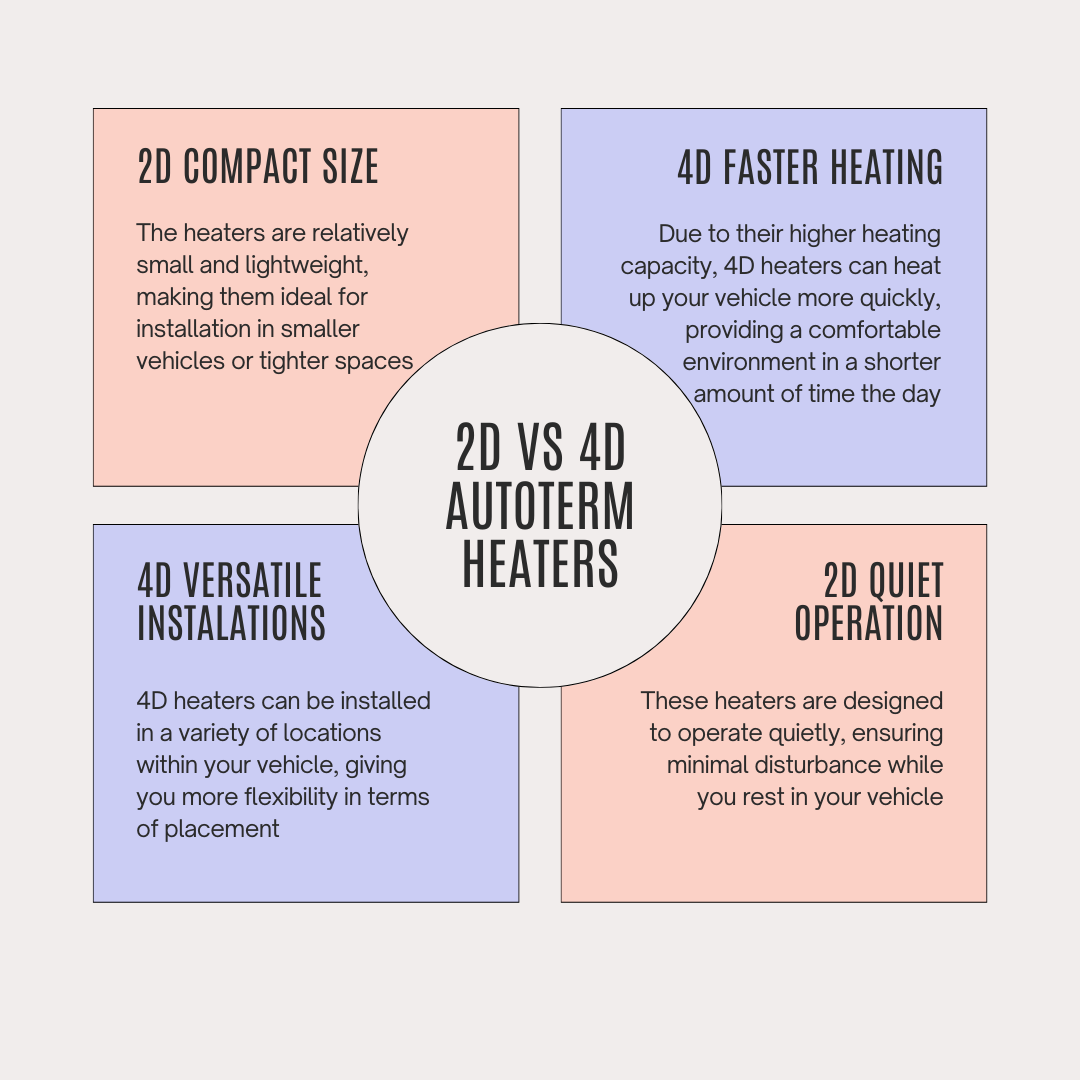
Compact Size: These heaters are relatively small and lightweight, making them ideal for installation in smaller vehicles or tight spaces.

Low Power Consumption: 2D heaters are designed to operate on low power, making them suitable for use in vehicles with limited electrical capacity.

Quiet Operation: These heaters are designed to operate quietly, ensuring minimal disturbance while you rest in your vehicle.

4D Autoterm Heaters:

Increased Heating Capacity: 4D heaters offer a higher heating capacity compared to 2D models, making them suitable for larger vehicles or colder climates.

Faster Heating: Due to their higher heating capacity, 4D heaters can heat up your vehicle more quickly, providing a comfortable environment in a shorter amount of time.

Greater Fuel Efficiency: While 4D heaters consume more fuel than 2D models, they are still highly efficient, ensuring optimal fuel consumption for the amount of heat produced.

Versatile Installation Options: 4D heaters can be installed in a variety of locations within your vehicle, giving you more flexibility in terms of placement.

Now with an understanding between the differences between a 2D and a 4D, here are some factors that will help you choose which option is the right one for you:

Vehicle Size: Consider the size of your vehicle and the amount of space available for heater installation. Smaller vehicles may benefit from the compact size of a 2D heater, while larger vehicles may require the increased heating capacity of a 4D model.

Climate: If you frequently travel in colder climates, a 4D heater may be more suitable due to its higher heating capacity and faster heating times.

Electrical Capacity: Ensure that your vehicle has the necessary electrical capacity to power the heater of your choice. 2D heaters are ideal for vehicles with limited electrical capacity, while 4D heaters may require more power.

Budget: Consider your budget and the overall cost of the heater, including installation and maintenance expenses. 2D heaters are generally more affordable than 4D models.

In conclusion, choosing between a 2D and 4D Autoterm heater depends on your specific needs and requirements. Consider factors such as vehicle size, climate, electrical capacity, and budget to determine which model is right for you.


People Also Ask:

Q. What is a NordicStove oil heater best for?

A. NordicStove oil heaters are best for providing reliable, non-electric heat in extreme cold and off-grid environments. These heaters are engineered for rural homes, cabins, marine vessels, and remote facilities where dependable heat is critical. Because many models operate without electricity, they continue working during power outages. As a North American importer, Rural Energy supplies NordicStove systems designed for long service life, steady heat output, and safe vented operation in harsh climates.

Q. Who should use a NordicStove oil heater?

A. NordicStove oil heaters are ideal for rural homeowners, off-grid property owners, contractors, and remote commercial facilities. Rural and off-grid homeowners benefit from dependable primary or backup heat that does not rely on grid power. Recreational cabin owners value durability and freeze-protection reliability during intermittent use. Contractors and facility managers appreciate straightforward installation and long-term parts availability supported by Rural Energy.

Q. Can a NordicStove oil heater handle extreme sub-zero conditions?

A. Yes, NordicStove oil heaters are designed to operate reliably in extreme sub-zero temperatures. These systems are proven in northern climates where winter temperatures drop well below zero. Oil-fired combustion remains stable in cold conditions, and direct-vent configurations help protect indoor air quality while maintaining consistent heat output. They are well-suited for Alaska, northern Canada, and mountain regions where performance cannot be compromised.

Q. Is a NordicStove oil heater suitable for off-grid cabins?

A. Yes, many NordicStove models are well-suited for off-grid cabins and remote properties. Non-electric operation allows the heater to function without utility power, reducing electrical demand while maintaining comfortable indoor temperatures. This makes them practical for cabins powered by generator or solar systems and effective for protecting plumbing from freezing during winter.

Q. How durable is a NordicStove oil heater in remote environments?

A. NordicStove oil heaters are built for long-term durability in harsh climates and remote installations. Constructed with heavy-duty components and engineered for cold-weather operation, they are designed to perform where service access is limited. Oil-fired systems provide stable combustion and consistent heat delivery over extended run times, supported by OEM parts availability through RuralEnergy.com.

Q. What heating performance can users expect from a NordicStove oil heater?

A. Users can expect steady, even heat output designed for primary heating in cold-climate structures. Oil-fired heaters provide consistent radiant and convective warmth, making them effective for medium to large spaces depending on model size. Direct-vent designs improve safety by drawing combustion air from outside and exhausting flue gases outdoors for dependable daily performance.

Q. Does a NordicStove oil heater require electricity to operate?

A. Many NordicStove oil heater models are designed to operate without electricity. Non-electric models rely on mechanical controls and oil combustion rather than electronic ignition systems, making them valuable during outages or in fully off-grid installations. This independence from grid power improves resilience and peace of mind in rural settings.

Q. What venting systems work with NordicStove oil heaters?

A. NordicStove oil heaters typically use approved direct-vent or compatible oil-venting systems rated for the appliance. Proper venting ensures safe combustion and compliance with clearance requirements. Double-wall and insulated vent systems are commonly used to improve safety and installation flexibility in tight spaces, especially in cold-climate applications.

Q. Is a NordicStove oil heater easy to maintain in remote areas?

A. Yes, NordicStove oil heaters are designed for straightforward maintenance, even in remote locations. Oil-fired systems require periodic cleaning and inspection, but their mechanical simplicity reduces dependency on specialized electronics. Access to replacement parts and service documentation through RuralEnergy.com helps owners and technicians perform routine upkeep with confidence.

Q. How does a NordicStove oil heater compare to other oil heaters or gas direct-vent systems?

A. NordicStove oil heaters stand out for non-electric capability and proven extreme-cold performance. Compared to many gas direct-vent systems, oil heaters can be advantageous in areas where fuel oil is readily available and power outages are common. NordicStove units are engineered for northern climates and long-term durability, making them a practical choice for homeowners and facilities prioritizing resilience and reliable heat.


Explore Other News Vault Articles:

To top