Cool your home in summer and heat it in winter with ductless mini split heat pumps from GREE and Toyotomi, plus the Toyotomi TAD-T33 dual-duct portable air conditioner. Choose matched indoor and outdoor units from 9,000 to 24,000 BTU. Need help choosing? Contact us or find a dealer near you.
People Also Ask
Q. What is a mini-split system?
A. A mini-split is a type of HVAC system that does not require ductwork. Also called ductless mini-splits, these systems provide cool air using the same cooling principles as compressor-driven central air conditioners. However, many mini-splits also have heat pump capabilities, allowing them to provide warm air during cool weather. A mini-split can be a cost-effective and energy efficient way to maintain a comfortable indoor temperature year-round.
Q. What is the difference between an air conditioner and a heat pump?
A. An air conditioner only cools, by moving heat from inside your home to the outdoors. A heat pump does the same in summer, then runs in reverse in winter to bring heat indoors, so one system both heats and cools. Heat Pump Splits in Extreme Climates
Q. How is a ductless mini-split different from central air?
A. Instead of blowing air through ducts from a central air handler, a ductless mini-split places the air handler directly inside the occupied room. Unlike a central air system, which has a single air handler, multi-zone mini-splits have several independent air handlers.
Q. What's the difference between single and multi-zone ductless mini-splits?
A. Single zone mini-splits have one indoor air handler and one outdoor condenser. A multi-zone system uses a single condenser to provide cooling to several indoor air handlers, each of which is connected by a refrigerant line set to the condenser. This allows the system to cool more space, and to cool separate spaces independently with independent thermostats.
Q. Does a ductless mini-split’s air handler have to hang on the wall?
A. No. The air handler should be installed above floor level, but it can be recessed in the ceiling or hidden entirely with a short piece of ductwork.
Q. How does ductless mini-split air conditioning work?
A. Air conditioning systems work by capturing heat energy inside a space and transporting it outside. Coolant flows in a closed loop between an interior air handler, where an evaporator coil absorbs heat from the indoor air to an exterior condenser, where a compressor “squeezes” heat from the coolant and expels it into the outdoor air. A mini split eliminates the need for ducts because the air handler is placed inside the room, mounted on a wall, or recessed in the ceiling. The air handler fan is able to blow air across its coils and directly into the room.
Q. How does ductless mini-split heating work?
A. By reversing the coolant circuit, coolant is forced to evaporate in the outside unit’s coils and condense in the indoor air handler, effectively “pumping” heat into the building. Heat pumps are much more efficient than the electric resistance heating used by electric furnaces and space heaters. According to Energy Star, certified heat pumps use 60% less energy than electric resistance heating.
Q. Are mini split units more efficient than other air conditioning systems?
A. Yes, there are several reasons why mini-split systems are efficient over a central air system. A mini-split efficiency advantage when compared with central HVAC is the lack of ductwork, more than 30% of the energy used in central air conditioning systems can be lost through ductwork. Ductless mini splits also have an efficiency advantage when compared with window units and portable air conditioners. In a mini-split system, the evaporator and condenser are on opposite sides of an insulated exterior wall. No heat can leak from the hot condenser coils outside to the cold evaporator coils inside. Importantly, zone systems allow separate spaces within a building to be heated or cooled independently, which helps prevent energy from being wasted in unoccupied spaces, or in spaces that are already at an acceptable temperature.
Q. Do I need both an indoor and an outdoor unit?
A. Yes. A mini split pairs an indoor unit with a matching outdoor unit, and we sell them separately. Match the BTU size and voltage, for example a Toyotomi 12,000 BTU 115V indoor unit with its 12,000 BTU 115V outdoor unit.
Q. What size mini split do I need?
A. It depends on the room size, insulation, and climate. Each unit lists its BTU rating. For help sizing, contact us or your dealer.
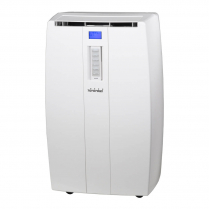
Q. What is a dual-duct portable air conditioner?
A. It uses one hose to pull outdoor air in to cool the unit and a second hose to send hot air outside. That way it does not pull cooled air out of your room the way single-hose models do.