
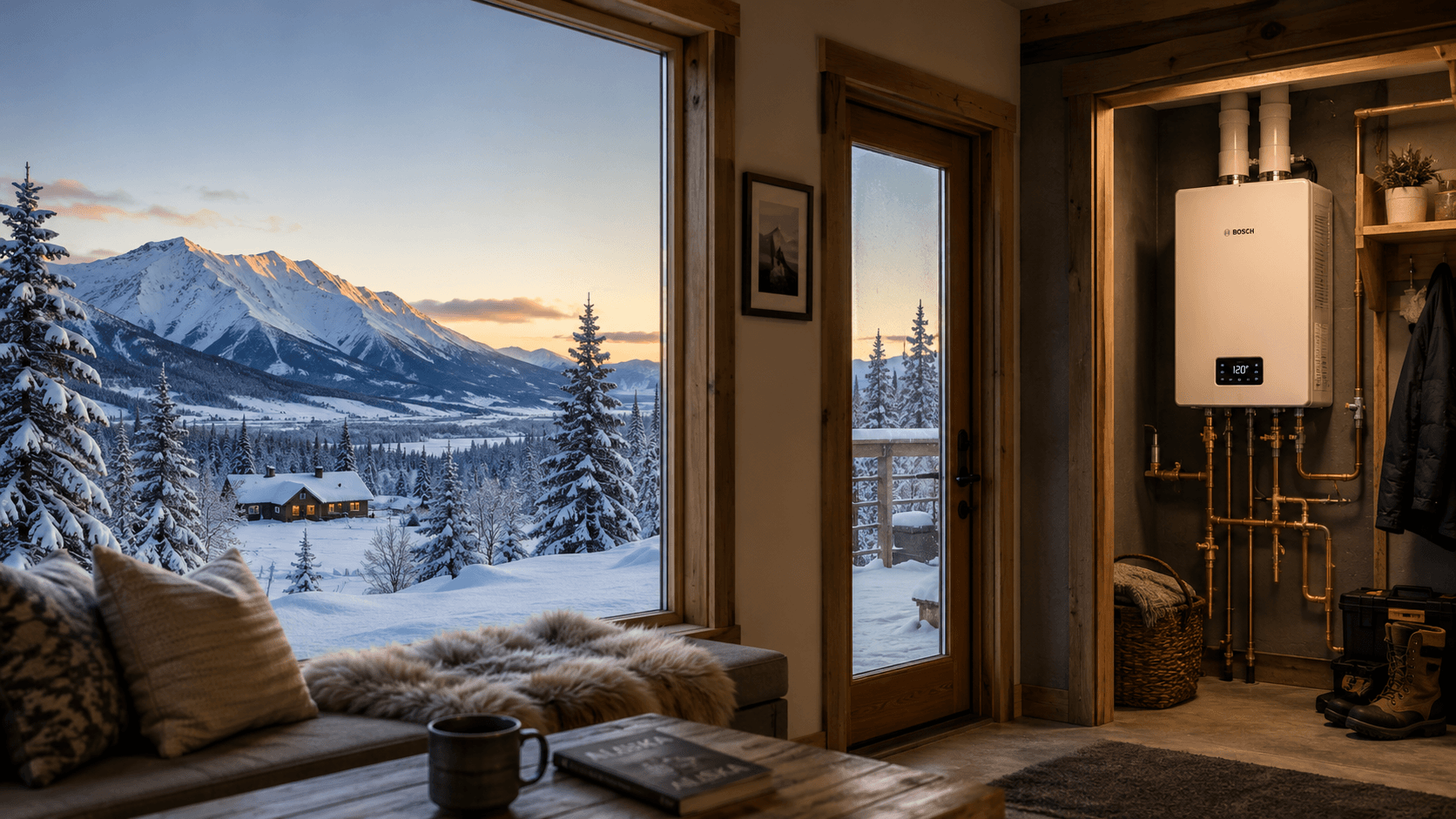
In Alaska and other cold-climate regions, a water heater works harder than almost anywhere else in the country. Incoming groundwater can arrive at 35–45°F in winter. A traditional storage tank keeps reheating that cold water around the clock, burning fuel even when nobody is using hot water. And when something goes wrong in a remote location, a service call is expensive.
Bosch Therm gas tankless water heaters address the standby heat loss problem directly, but they are not a plug-and-play swap for every property. In cold climates, the unit has to be sized for real winter groundwater temperatures and real fixture demand, not the flow-rate numbers printed on a warm-climate spec sheet.
Rural Energy has supplied Alaska and the Pacific Northwest with water heating equipment for over 37 years. This guide covers what you need to know before buying a Bosch Therm unit for a cold-climate property:
How tankless heating works and why it matters in cold climates
How Alaska groundwater temperatures affect the delivered flow rate
Which Bosch Therm models Rural Energy stocks and how to choose between them
Installation requirements that matter most in sub-zero and rural settings
A tankless water heater, also called an on-demand water heater, heats water only when a fixture calls for it. There is no storage tank, no pilot flame keeping 40 or 50 gallons warm between uses, and no standby heat loss.
Key point: The U.S. Department of Energy identifies standby heat loss as a primary source of energy waste in conventional water storage heaters. In cold climates, that waste is amplified because the tank is constantly fighting colder ambient temperatures and colder incoming water.
In Alaska, the Pacific Northwest, and similar cold-climate regions, standby loss compounds quickly. A storage tank in an unheated mechanical room in Fairbanks is working harder in January than the same tank in Phoenix ever will. Eliminating that constant reheat cycle is where tankless systems earn their efficiency advantage in northern climates.
Why gas matters in Alaska and cold-climate regions:
Natural gas and propane are the most widely available fuels across Rural Energy's service area
Electric resistance heating is expensive per BTU in Alaska, where electricity rates are among the highest in the country
Gas-fired tankless units like the Bosch Therm series deliver high BTU output in a compact footprint, which matters in tight mechanical spaces
The Bosch Therm series is Bosch's gas-fired, on-demand product line for residential and light commercial applications. It is a completely separate line from the Bosch Tronic electric tank and mini-tank products.
The operating sequence is straightforward. Cold water enters the unit, a flow sensor detects demand and activates the burner, the heat exchanger transfers heat to the water, and hot water exits at the set temperature. There is no stored volume to deplete and no recovery time between draws.
Bosch Therm units use a modulating burner that adjusts output to match current demand rather than running at one fixed rate. As Bosch Thermotechnology notes, this thermostatic modulation keeps outlet temperature consistent even as inlet temperature varies, which is exactly what you need when Alaska groundwater shifts between seasons.
Key specs for the stocked models:
Bosch Therm 830 ES: 175,000 BTU/h maximum input
Bosch Therm 940 ES: 199,000 BTU/h maximum input
Both models: UEF up to 0.92, built-in freeze protection, sealed combustion
Proper venting and gas supply are not secondary details in a cold-climate installation. They are core performance variables.
Bosch Therm units require direct venting with rated stainless steel pipe in sub-zero installations. PVC vent pipe can become brittle at extreme temperatures.
Maximum vent run is approximately 29 ft for 3-inch stainless steel and 61 ft for 4-inch stainless steel, per Bosch installation documentation.
An undersized gas line or regulator is one of the most common causes of poor field performance and is often misdiagnosed as a unit problem.
This is where most tankless buying decisions go wrong in Alaska and other cold-climate regions. Advertised flow rates are tied to a specific temperature rise assumption, and that assumption rarely matches Alaska winter conditions.
Alaska winter groundwater commonly runs 35–45°F. Interior Alaska is often closer to 35–40°F. Warmer states typically see 55–70°F groundwater, which serves as the baseline for many published GPM ratings.
To deliver hot water at a 120°F setpoint with 40°F inlet water, the unit needs to produce an 80°F temperature rise. That is a very different ask than the 45–50°F rise assumed in lower-48 sizing charts.
The math that matters:
A useful field approximation: delivered GPM equals rated GPM at a 35°F rise, multiplied by 35, divided by your actual temperature rise.
For a unit rated at 6.6 GPM:
At a 75°F rise (45°F inlet, 120°F output): approximately 2.8–3.1 GPM delivered
At an 80°F rise (40°F inlet, 120°F output): approximately 2.6–2.9 GPM delivered
That is still workable. A low-flow showerhead runs around 1.8–2.0 GPM. A kitchen faucet adds another 1.5–2.0 GPM. One shower plus one additional fixture is realistic for most homes. The problem comes when buyers expect warm-climate performance in an Alaska winter without sizing for real conditions.
"When you ask them to do an 80°F rise, the available GPM drops dramatically." — Rural Energy
Calculate simultaneous demand at Alaska winter inlet temperatures, not at the label GPM:
List every fixture that could run at the same time
Add up their flow rates (low-flow showerheads at 1.8 GPM, standard faucets at 1.5–2.0 GPM)
Determine your winter inlet temperature (35–40°F for Interior Alaska, 40–45°F for coastal areas)
Select a model that meets that demand at a 75–85°F temperature rise
For most single-family homes in Alaska, one shower plus one additional fixture is the realistic target. Larger households or properties with higher demand should size up to the 940 ES.
Bosch Therm units include built-in freeze protection for the unit itself. The Bosch owner's manual is direct: do not rely solely on internal freeze protection, and install per Bosch venting specs to prevent back-draft. In sub-zero conditions, components can freeze and burst if there is negative draft in the vent system.
Supply and output piping in unheated spaces still need insulation or heat trace regardless of the unit's built-in protection. regardless of the unit's built-in protection.
The right choice depends on which fuel is available at your property and what your simultaneous hot-water demand looks like. For a broader breakdown of the tank vs. tankless decision, see Rural Energy's tank or tankless comparison guide. This section focuses specifically on the Bosch Therm gas tankless.
|
Factor |
Bosch Therm Gas Tankless |
Electric Storage Tank |
|---|---|---|
|
Standby heat loss |
None |
Constant, worse in cold climates |
|
Fuel |
Propane or natural gas |
Electricity |
|
Operating cost in Alaska |
Lower gas is typically cheaper per BTU |
Higher, Alaska electricity rates are among the highest in the U.S. |
|
Hot water supply |
Unlimited on-demand |
Limited by tank size and recovery rate |
|
Installation |
Requires a gas line and rated venting |
Simpler; no gas or venting required |
|
Best fit |
Homes with propane or NG access and moderate-to-high hot water demand |
Off-grid properties with solar or battery power and modest flow needs |
Three-question decision guide:
Do you have propane or natural gas at the property? If yes, Bosch Therm is worth sizing.
Is your simultaneous demand one to two fixtures at a time? Bosch Therm handles that well in Alaska winter conditions when sized correctly.
Is your only fuel source electricity, or do you have very modest hot water needs? An electric storage tank or point-of-use unit may be the more practical fit.
For properties without gas access, Rural Energy also stocks the Bosch Tronic electric series for off-grid and low-demand applications.
Rural Energy stocks four Bosch Therm models across two capacity tiers and two fuel types. Both tiers are available in propane (LP) and natural gas (NG).
|
Model |
Fuel |
Max Input |
GPM at 35°F Rise |
GPM at 55°F Rise |
|---|---|---|---|---|
|
Propane |
175,000 BTU/h |
8.3 GPM |
5.3 GPM |
|
|
Natural Gas |
175,000 BTU/h |
8.3 GPM |
5.3 GPM |
|
|
Propane |
199,000 BTU/h |
9.4 GPM |
6.0 GPM |
|
|
Natural Gas |
199,000 BTU/h |
9.4 GPM |
6.0 GPM |
The 830 ES is the right fit for smaller homes and lower simultaneous demand. At 175,000 BTU/h, it delivers adequate flow for one shower plus one additional fixture under Alaska winter conditions, with inlet water in the 40–45°F range. It is the more common choice for single-family cabins, smaller rural homes, and properties where peak demand rarely exceeds two fixtures at once.
Both the LP and NG variants carry a 15-year warranty and an expected service life of 20 or more years with proper maintenance.
The 940 ES adds 24,000 BTU/h of input capacity over the 830 ES, which translates to meaningfully better delivered flow when the inlet water is coldest. For larger households, properties with multiple bathrooms, or any installation where simultaneous demand regularly reaches two full showers, the 940 ES is the safer choice. It is also the better fit for Interior Alaska locations where groundwater sits at the lower end of the 35–40°F range.
The fuel type choice (LP vs. NG) is determined by what is available at the property. There is no performance difference between the LP and NG variants at the same BTU rating.
Cold-climate installation introduces variables not found in standard residential tankless guides. These are the ones that matter most for Alaska, the Pacific Northwest, and similar northern regions.
Location: Install in a conditioned or semi-conditioned space whenever possible. Units in unheated garages or exterior mechanical rooms need additional freeze protection for surrounding pipe runs, not just the unit itself.
Venting materials: Use a rated stainless steel vent pipe for sub-zero installations. PVC becomes brittle in extreme cold and is not appropriate for Alaska conditions. Follow Bosch's specified maximum vent lengths: approximately 29 ft for 3-inch stainless, 61 ft for 4-inch stainless.
Vent termination: Termination placement matters in cold climates. Improper termination can create back-draft conditions that allow cold air into the vent system. Per Bosch's installation manual, a negative draft in the vent system can cause internal components to freeze and burst.
Gas supply: Confirm that the gas line and regulator can meet the unit's BTU demand before installation. An undersized regulator is the most common field problem and is frequently misdiagnosed as a unit defect.
Pipe insulation: Insulate or heat-trace all supply and output piping in unheated spaces. The unit's built-in freeze protection does not cover exterior or uninsulated pipe runs.
Water quality: In areas with hard water, scale buildup reduces heat exchanger efficiency over time. Annual descaling is recommended for high-use applications in cold-climate regions. Expect a service life of 15–20 years with proper maintenance, compared to 8–12 years for a conventional storage tank.
For guidance on installation requirements specific to your property type or location across Alaska and the Pacific Northwest, Rural Energy's team is available to advise before purchase.
Can a Bosch tankless water heater handle Alaska's cold groundwater temperatures?
Yes, with the right sizing. Alaska winter groundwater typically runs 35–45°F, which means the unit needs to produce a 75–85°F temperature rise to deliver hot water at a 120°F setpoint. That reduces delivered flow compared to warmer-state specs, but it does not make the unit unsuitable. Most residential applications in Alaska require one shower plus one additional fixture at a time, which the Bosch Therm 830 ES and 940 ES can meet when sized for actual winter inlet temperatures rather than label GPM. Interior Alaska properties with groundwater in the 35–40°F range should size toward the 940 ES.
What is the difference between the Bosch Therm and the Bosch Tronic?
The Bosch Therm series is a gas-fired, on-demand, tankless product line designed for whole-home or light-commercial hot water supply. The Bosch Tronic series covers electric tank and point-of-use mini-tank products. They serve different applications, use different fuel sources, and have different installation requirements. This guide covers only the Bosch Therm gas tankless line. If your property does not have gas access, the Tronic electric series or a conventional electric tank may be a better fit.
How long do Bosch tankless water heaters last in cold climates?
With proper installation and maintenance, Bosch Therm units are generally expected to last 15–20 years. That compares favorably to a conventional storage tank, which typically runs 8–12 years. In cold-climate regions with hard water, annual descaling is the most important maintenance task to protect the heat exchanger's efficiency and extend its service life. Proper venting and freeze protection for surrounding pipes are the installation factors most likely to affect long-term reliability in Alaska and similar northern climates.
Bosch Therm can be a strong fit for Alaska, the Pacific Northwest, and other cold-climate properties when the property has gas access, and the unit is sized for real winter temperature rise, not warm-climate label ratings.
Start by comparing the 830 ES and 940 ES based on your household's simultaneous fixture demand and fuel type. If you are unsure about sizing, gas supply capacity, venting requirements, or installation conditions for your specific property, contact Rural Energy. We have supplied Alaska and the Pacific Northwest with water heating solutions for over 37 years and can advise on the right fit before you buy.
A. You can, but it requires more planning than an interior installation. The unit's built-in freeze protection covers the heat exchanger and internal components down to around 20°F, but the water supply lines, gas line, and vent pipe in an unheated space are all vulnerable below that threshold. For outbuilding installations in Alaska or other sub-zero climates, heat tracing on all water piping, a conditioned enclosure around the unit, and careful placement of vent terminations are required, not optional. If the outbuilding regularly drops below -20°F, a point-of-use electric unit closer to the fixture may be a more reliable option.
A. Bosch Therm units modulate burner output based on available gas pressure and demand. If gas pressure falls below the minimum threshold during a heavy cold snap, the unit will reduce output or fail to ignite rather than silently deliver undertemperature water. The practical risk in Alaska and rural areas is that propane tanks can experience pressure drops when temperatures fall sharply and the tank level is low. Keeping propane tanks above 30% in winter and confirming regulator ratings for sub-zero operation are the two most effective ways to prevent cold-snap pressure issues.
A. Yes, with a proper winterization plan. When the cabin is unoccupied, the water supply to the unit should be shut off and the unit drained completely. Bosch Therm units have a built-in low-temperature protection mode, but that protection is not a substitute for draining in a property that loses heat entirely. When the cabin is reopened in spring, a quick inspection of the vent termination for debris or ice blockage and a check of the water connections before relighting is good practice.
A. Not reliably as a single-appliance solution. Bosch Therm units are designed for potable domestic hot water delivery, not for closed-loop hydronic heating applications. Running a radiant floor system through a domestic tankless unit creates water quality issues, pressure compatibility problems, and voids the warranty. If you need both domestic hot water and radiant heat from a single gas appliance, a dedicated combination boiler or an indirect water heater paired with a hydronic boiler is the correct approach. Rural Energy can advise on system design for dual-use applications.
A. Hard water causes mineral scale to accumulate on the heat exchanger over time, reducing efficiency and eventually causing flow restriction or hot spots. Alaska groundwater hardness varies significantly by location. Coastal areas and glacier-fed wells tend to be softer, while some Interior Alaska and Pacific Northwest well water can be moderately hard. If your water hardness exceeds 11 grains per gallon, annual descaling is recommended. A whole-house sediment filter upstream of the unit is also worth considering in areas with particulate-heavy well water, as debris can damage the flow sensor.
A. Bosch Therm units have a minimum activation flow rate, typically around 0.5 GPM. Below that threshold, the flow sensor does not trigger the burner, and the unit stays off. In practice, this means that very low-flow fixtures, such as some older aerator faucets, may not activate the unit consistently. If you notice cold water from a specific tap that works fine elsewhere, check the fixture's flow rate first. Replacing a low-flow aerator with one rated at 0.6 GPM or higher usually resolves the issue without any changes to the unit.
A. Yes. Bosch Therm units require a standard 120V electrical connection for the control board, ignition system, and freeze protection components. The amperage draw is low, typically 2–3 amps, so a shared circuit is sometimes used in practice, but a dedicated circuit is recommended to avoid nuisance tripping and to ensure the freeze protection system stays powered even if other circuits are tripped. In remote properties with generator or inverter power, confirm that the power supply is stable and within voltage tolerance before installation.
A. The Bosch Therm 830 ES and 940 ES are non-condensing units with a UEF up to 0.92. Condensing tankless units can reach UEF values of 0.95 or higher by extracting additional heat from the exhaust gases, thereby lowering flue gas temperatures. In very cold climates, lower flue temperatures in a condensing unit can actually increase the risk of condensate freezing in the vent system if the installation is not designed for it. For most Alaska and Pacific Northwest residential applications, the 0.92 UEF of the Bosch Therm 830 ES and 940 ES represents a strong efficiency advantage without the added condensate-management complexity of a fully condensing unit.
A. Yes. Parallel installation of two Bosch Therm units is a recognized approach for larger homes, lodges, or light commercial properties with simultaneous demand that exceeds what a single unit can deliver at Alaska winter inlet temperatures. Each unit operates independently and fires only when demand reaches its activation threshold. The practical consideration is that parallel installations require careful gas line sizing to supply both units at full BTU draw simultaneously, and each unit needs its own properly designed vent run. Rural Energy can assist with sizing and layout for multi-unit installations.
A. In the first year, the most important tasks are a vent inspection after the first winter season and a flow filter screen check at the cold water inlet. Cold-climate installations can introduce debris from pipes disturbed during installation, and the inlet filter screen can restrict flow if it catches sediment. Beyond that, confirm the unit is firing cleanly and modulating as expected across the demand range, from low-flow fixtures to full simultaneous use. Annual descaling becomes the primary maintenance task from year two onward, depending on water hardness. A well-maintained Bosch Therm unit in a cold climate should reach 15–20 years of service life without major component replacement.