
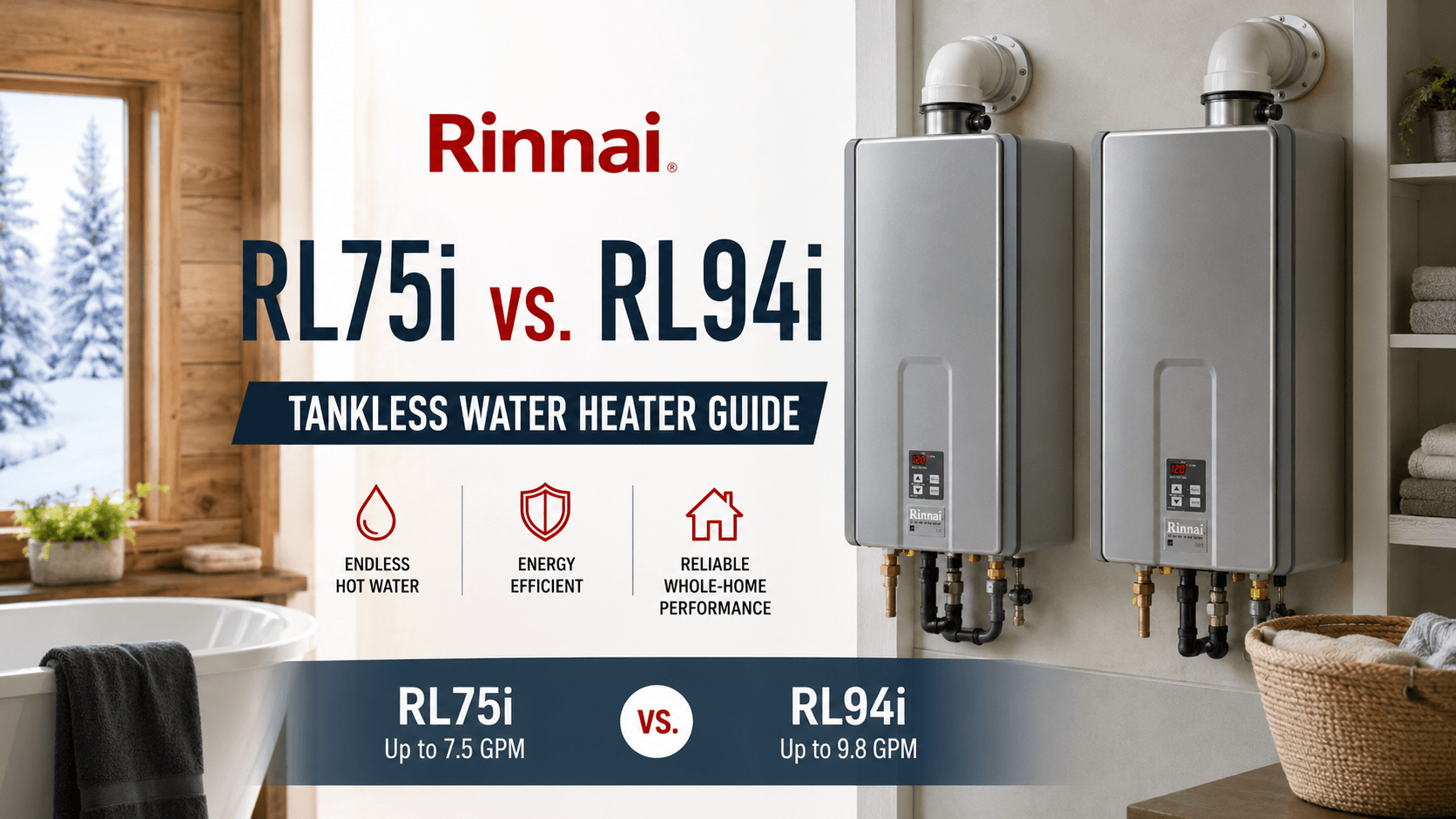
How flow rate, fixture demand, and cold-weather performance shape the better choice
Both the Rinnai RL75i and RL94i are indoor, non-condensing tankless water heaters from the same RL series. They share the same design philosophy, fuel options, and installation footprint. The difference that matters at the point of purchase is output capacity: how much hot water each unit can deliver when multiple fixtures are running simultaneously.
For most households, that distinction is straightforward. For homes in Alaska or other cold climates, it becomes more consequential. Colder incoming water requires a larger temperature rise to reach a comfortable delivery temperature, reducing the usable flow rate below the headline GPM figure on the spec sheet.
This guide covers:
The key specs and use-case differences between the RL75i and RL94i
How to size by simultaneous fixture demand and incoming water temperature
Which model fits smaller homes, larger homes, and cold-climate installations
Fuel variants, freeze protection, and where to find full specs and parts
The RL75i and RL94i share the same indoor, non-condensing platform. The decision between them comes down to two numbers: maximum flow rate and BTU input.
|
Spec |
Rinnai RL75i |
Rinnai RL94i |
|---|---|---|
|
Max flow rate |
7.5 GPM |
9.8 GPM |
|
BTU input (NG) |
Up to 180,000 BTU/h |
Up to 199,000 BTU/h |
|
Flow at 45°F rise |
~6.6 GPM |
~7.1 GPM |
|
Simultaneous fixtures |
3 to 4 (moderate conditions) |
4 to 5 (typical conditions) |
|
Best for |
Smaller homes, 1 to 2 bathrooms |
Larger homes, 2 to 3+ bathrooms |
|
Fuel options |
Natural gas (RL75iN) / Propane (RL75iP) |
Natural gas (RL94iN) / Propane (RL94iP) |
|
Type |
Non-condensing, indoor |
Non-condensing, indoor |
|
Freeze protection |
-22°F (with gas, power, and wind protection) |
-22°F (with gas, power, and wind protection) |
Verify current BTU, UEF, dimensions, and warranty figures against the live Rural Energy PDPs before publication.
Three things to take from this table:
The RL94i delivers approximately 30% higher maximum GPM than the RL75i, which is a meaningful margin when multiple fixtures run simultaneously.
At a 45°F temperature rise, the gap narrows, but the RL94i still maintains a usable advantage, which is particularly relevant for cold-climate homes where temperature-rise requirements are higher.
Both models are available in natural gas and propane variants, so fuel type is a SKU selection, not a model-level constraint.
In plain terms: A tankless water heater heats water on demand as it flows through the unit, rather than storing a pre-heated supply in a tank. There is no standby heat loss, and hot water does not run out as long as demand stays within the unit's rated capacity.
The RL series is part of Rinnai's non-condensing indoor lineup. Non-condensing means the unit vents exhaust gases through a standard flue without extracting a second stage of heat from them, which simplifies installation compared to condensing models. The trade-off is slightly lower efficiency, but the RL series is a proven, widely installed platform with a long service record.
Why tankless suits rural and remote homes:
No tank means a smaller installation footprint, useful in utility rooms, closets, and mechanical spaces where square footage is limited.
Continuous hot water output (within rated GPM) works well for households that cannot tolerate running out mid-shower or mid-load.
Long service life relative to storage tank heaters, which matters when replacement logistics are more involved in remote locations.
Both natural gas and propane variants are available, covering homes on utility gas and those relying on delivered LP.
For buyers comparing the RL series against condensing options, Rural Energy also stocks the Rinnai RU199i, a higher-efficiency condensing model worth reviewing if maximum efficiency is the primary criterion.
Choosing between the RL75i and RL94i is a sizing decision. The right starting point is not the max GPM figure on the spec sheet; it is the realistic simultaneous hot-water demand in the home, adjusted for incoming water temperature.
Each fixture draws a baseline flow rate. Running multiple fixtures at once stacks that demand against the unit's output capacity.
|
Fixture |
Typical flow rate |
|---|---|
|
Standard shower |
1.5 to 2.0 GPM |
|
Low-flow shower |
1.0 to 1.5 GPM |
|
Kitchen sink |
1.0 to 1.5 GPM |
|
Bathroom sink |
0.5 to 1.0 GPM |
|
Dishwasher |
1.0 to 1.5 GPM |
|
Clothes washer |
1.5 to 2.0 GPM |
A household running one shower and one sink simultaneously needs roughly 2.5-3.0 GPM of hot water. Two showers plus a sink push that to 4.0-5.0 GPM. At those levels, incoming water temperature starts to matter.
The U.S. Department of Energy notes that tankless output depends directly on the required temperature rise: the difference between incoming cold water and the desired delivery temperature. As that gap widens, available GPM drops.
Rinnai's own flow data confirms this: at a 45°F temperature rise, the RL75i delivers approximately 6.6 GPM and the RL94i approximately 7.1 GPM. Both figures are meaningfully lower than their headline maximums.
Cold-climate reality: "The colder your incoming water, the larger the needed temperature rise (ΔT), and the lower the available GPM." — Rinnai flow curves and tables
In Alaska, groundwater temperatures can sit well below 45°F for much of the year. A home that might manage comfortably on an RL75i in a moderate climate may find itself undersized when inlet water is colder and temperature rise requirements increase.
Sizing a tankless unit to its rated maximum leaves no buffer for peak demand. A practical rule: the unit's usable output at the expected temperature rise should exceed your simultaneous fixture demand by at least 1.0 GPM. In cold climates, that margin should be wider, not narrower.
The RL75i is the right fit for smaller homes with limited simultaneous hot-water demand and one-shower-at-a-time usage patterns.
Ideal use cases:
Single-bathroom homes and smaller residences where two fixtures rarely run at the same time
Cabins, hunting camps, and seasonal properties with straightforward hot-water needs
Households in moderate climates where incoming water temperatures stay relatively consistent year-round
Replacement installations where the existing gas line and venting are sized for a unit in this BTU range
Properties where a second unit could be added later if demand grows
What to expect in practice:
At 7.5 GPM maximum and roughly 6.6 GPM at a 45°F temperature rise, the RL75i handles one shower plus a sink or dishwasher without difficulty in typical conditions. It reaches its limits in homes that regularly run two showers simultaneously, or in colder climates, where the effective output drops further as inlet water temperature falls.
The RL75i is available in two fuel variants:
RL75iN for natural gas
RL75iP for propane
Choose based on the fuel supply at the installation site. Both variants share the same flow rate and BTU input range; the difference lies in the combustion calibration for their respective fuel types. Verify current specs on the Rural Energy RL75i product page before specifying.
The RL94i is the safer choice for larger households, multi-bathroom homes, and any installation where incoming cold water will reduce the usable flow rate below a comfortable margin.
Ideal use cases:
Homes with 2 to 3 or more bathrooms where two showers may run at the same time
Larger families with higher peak-hour hot-water demand
Cold-climate installations in Alaska and similar regions where groundwater temperatures are low, and temperature rise requirements are significant
Properties where the household expects to add fixtures or increase occupancy over time
Contractors sizing a unit for a client who wants capacity headroom rather than a tight fit
What the extra capacity actually means:
As Rinnai's own specifications note, "the RL94i will still provide noticeably more GPM than the RL75i at the same rise due to higher BTU capacity." At a maximum of 9.8 GPM and approximately 7.1 GPM with a 45°F temperature rise, the RL94i maintains a usable buffer even during peak demand.
In practice, that gap matters most in cold climates. When incoming water is colder than 45°F, the required temperature rise increases and available GPM on both units drops. The RL94i's higher BTU input gives it more capacity to absorb that reduction without falling short of household demand.
The RL94i is available as:
RL94iN for natural gas
RL94iP for propane
Verify current specs on the Rural Energy RL94i product page before specifying.
Both models share the same core installation requirements and freeze-protection ratings. This section covers the practical details most buyers and contractors need before specifying.
Both the RL75i and RL94i are rated for freeze protection down to -22°F (-30°C), provided gas supply and electrical power are maintained and the unit is shielded from wind exposure. Rinnai's installation documentation includes an important caution: "Because of the 'wind-chill' effect, any wind or circulation of the air on the unit will reduce its ability to protect itself from freezing." In Alaska installations, proper siting and enclosure matter as much as the rated temperature floor.
|
Resource |
Where to find it |
|---|---|
|
Full spec sheet (GPM, BTU, UEF, dimensions, warranty) |
Rural Energy RL75i PDP / Rural Energy RL94i PDP |
|
Installation and operation manual |
Rural Energy product pages or Rinnai technical library |
|
Replacement parts (flame rod, ignitor, heat exchanger) |
Rural Energy parts pages for each model |
|
Fuel variant confirmation (N vs P) |
Listed in the SKU on the product page |
Minimum activation flow for both models is 0.4 GPM. The unit will not fire below that threshold, which is relevant for low-flow fixtures and point-of-use applications.
Recommended water pressure is 30 to 80 PSI. Installations outside that range should address pressure before commissioning the unit.
Always pull live specs from the Rural Energy PDPs before finalizing a specification; BTU range, UEF, and dimensional data should be confirmed against the current listing.
If the home is smaller, demand is lower, and fixtures rarely overlap, the RL75i is a capable, appropriately sized choice. If the household is larger, the climate is colder, or there is any expectation of simultaneous peak demand, the RL94i is the safer call. In cold climates especially, it is better to have capacity margin than to discover the unit is undersized after installation.
Browse the Rinnai RL75i at Rural Energy and verify current specs, pricing, and availability
Browse the Rinnai RL94i at Rural Energy for the higher-capacity option
Not sure which model fits your home? Contact Rural Energy for sizing help from a team that knows cold-climate installations.
A. The primary difference is flow rate. The RL75i has a maximum output of 7.5 GPM, while the RL94i reaches 9.8 GPM. Both are indoor, non-condensing tankless water heaters from the same RL series. The RL94i also has a higher BTU input, up to 199,000 BTU/h vs. 180,000 BTU/h, which gives it greater capacity to maintain output when incoming water is cold and temperature rise requirements are high.
A. It can be, depending on the number of bathrooms and simultaneous demand. For a single-bathroom home or a cabin where fixtures rarely run simultaneously, the RL75i is a practical whole-home unit. For homes with two or more bathrooms, or in cold climates where usable GPM drops with colder inlet water, the RL94i provides a safer margin.
A. Yes. Both the RL75i and RL94i are rated for freeze protection to -22°F when gas and power are maintained, and the unit is protected from wind. The more relevant cold-climate consideration is sizing: colder incoming water increases the required temperature rise and reduces usable GPM, which is why the RL94i is generally the recommended choice for Alaska installations.
A. Yes. Both models are available in propane variants: the RL75iP and RL94iP. Natural gas versions are the RL75iN and RL94iN. The flow rate and BTU input are the same across fuel types; the difference is combustion calibration. Confirm the correct fuel supply SKU for the installation site before ordering.
A. Colder incoming water forces a larger temperature rise to reach a comfortable delivery temperature, which directly reduces usable GPM on both models. At a 45°F temperature rise, the RL75i delivers approximately 6.6 GPM and the RL94i approximately 7.1 GPM, both meaningfully below their headline maximums. In Alaska and similar climates, groundwater can sit well below 45°F for much of the year, so the effective output gap between the two models widens under real operating conditions. This is the primary reason the RL94i is the recommended choice for cold-climate installations.
A. Both models require a minimum flow of 0.4 GPM to activate. Below that threshold, the unit will not fire. This is relevant for low-flow fixtures such as certain bathroom faucets or point-of-use applications where demand may not consistently reach the activation threshold. In most whole-home installations with standard fixtures, this is not a practical concern.
A. A dual-unit installation is technically possible and gives the household redundancy: if one unit requires service, the other continues to supply hot water. However, it also doubles the installation cost, requires additional gas supply capacity, and adds complexity to venting and controls. For most households, a single RL94i is the simpler and more cost-effective path to higher capacity. A dual-unit setup is worth considering for larger properties, commercial applications, or situations where redundancy has a clear operational value.
A. Tankless water heaters generally have a longer service life than storage tank units. Rinnai's RL series is a proven platform with a strong field record in residential and light commercial applications. Actual service life depends on water quality, maintenance frequency, and operating conditions. In areas with hard water, periodic descaling helps protect the heat exchanger and maintain performance over time. For current warranty terms on the RL75i and RL94i, refer to the live product pages on Rural Energy, as warranty coverage should be confirmed against the current listing before purchase.