
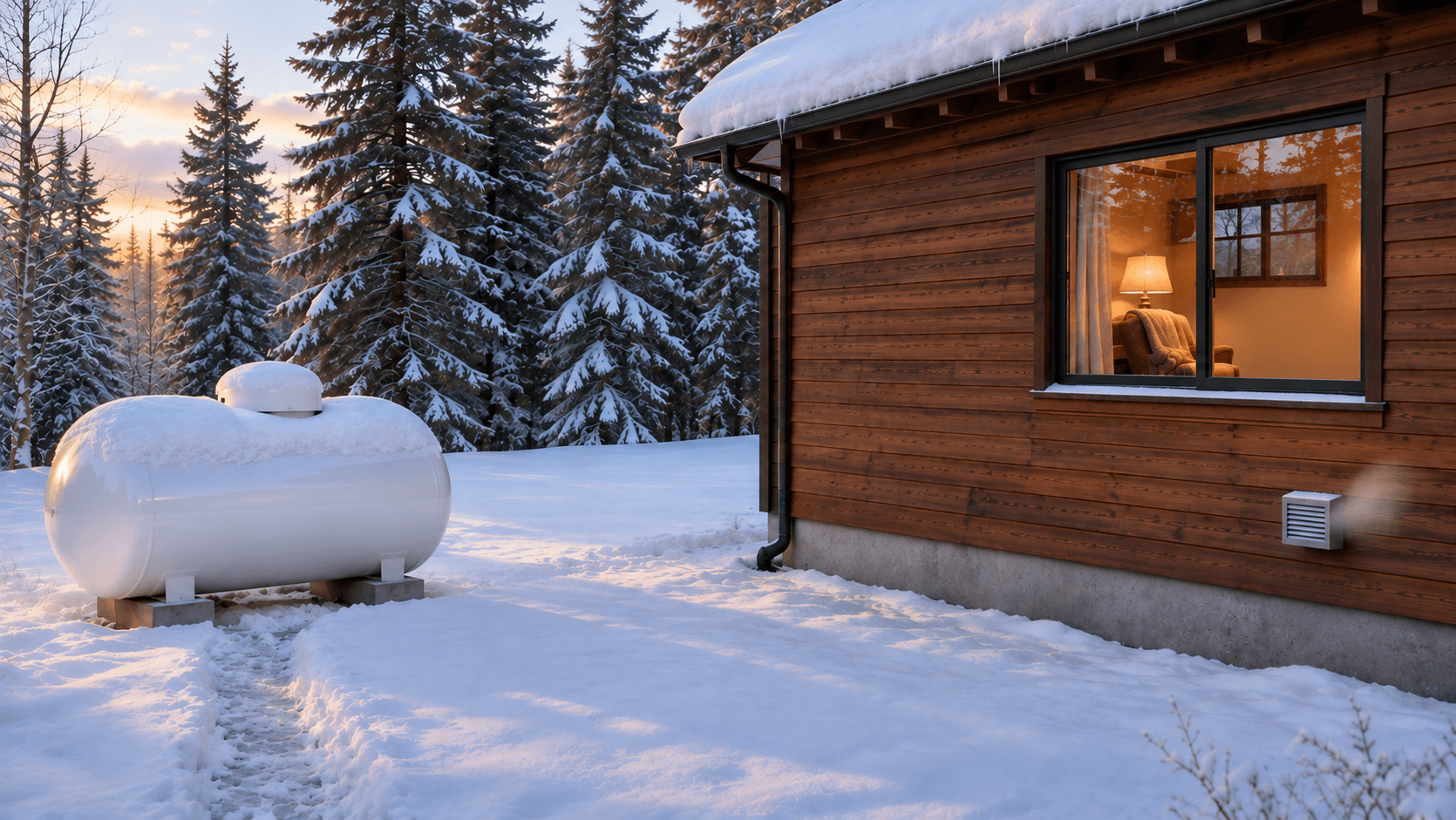
Divide your heater's BTU input rating by 91,452, the British thermal units in one gallon of propane per the U.S. Energy Information Administration, and you have the most it can burn in one hour at full input. A heater rated at 36,500 Btu, for example, burns about 0.40 gallons per hour at that ceiling. In practice your heater burns less, because the burner is not running every minute of every hour and, on modulating models, the valve turns down to match the gas rate to what the room actually needs.
A gas heater's input rating is expressed in British thermal units per hour, or Btu/h. You will find it on the rating plate fixed to the unit, on the specification sheet, and in the installation manual. It is the number the burner is designed to consume, not the heat the unit delivers to the room.
That distinction matters. A heater's output, sometimes called its heating capacity, is always lower than its input because some energy leaves through the flue or the venting system. When you want to know how much fuel a heater draws, the input is the only number that answers the question.
Modulating heaters, such as the Rinnai EnergySaver series, carry two input figures: a minimum and a maximum. The burner can run anywhere in that range depending on how much heat the room needs. Fixed-input heaters, such as the Empire DV series, have one figure. The burner is either on at that rate or it is off. In both cases the maximum input is the ceiling for fuel consumption per hour, and that is the number you divide by 91,452 to find the ceiling in gallons.
The U.S. Energy Information Administration publishes a standard conversion factor for propane: one gallon contains 91,452 Btu. That single constant is all you need to convert any heater's input rating into a fuel-use figure.
Gallons per hour at full input = BTU input rating / 91,452
To find the ceiling for a full 24 hours at full input, multiply by 24.
Gallons per 24 hours at full input = (BTU input rating / 91,452) x 24
The Rinnai EX38DTP has a maximum input of 36,500 Btu/h on propane. Dividing by 91,452 gives 0.40 gallons per hour at full input. Multiply by 24 and you get 9.6 gallons per 24 hours at full input. That 9.6-gallon figure is the ceiling: the EX38 running at its maximum rate without stopping for an entire day. The heater will not reach that figure in normal operation, because the thermostat cycles the burner off when the room reaches temperature and the modulating valve reduces the rate before that point.
The same arithmetic applies to every propane appliance: a water heater, a range, a clothes dryer. Find the input rating on the unit's label or in its manual, divide by 91,452, and you have the maximum gallons per hour for that appliance. The EIA constant does not change between appliances or between manufacturers. If you want to know the combined draw of every propane appliance on a shared tank, the method is the same; that calculation is covered in the section on adding up appliances below.
One note on the constant: the EIA figure of 91,452 Btu per gallon is the value used throughout this article and in the table below. Other technical references may list slightly different values depending on the measurement method; for planning propane use, the EIA figure is the appropriate one to use.
The table below applies the formula to the propane wall furnaces Rural Energy carries. The 24-hour column is a ceiling in every case: the burner running at full input without interruption for an entire day. Normal operation will be lower.
|
Model (propane) |
Input Btu/h |
Gallons per hour at full input |
At minimum input |
Gallons per 24 hours at full input (ceiling) |
|---|---|---|---|---|
|
3,000 to 8,000 |
0.09 |
0.03 |
2.1 |
|
|
5,700 to 11,000 |
0.12 |
0.06 |
2.9 |
|
|
8,700 to 16,700 |
0.18 |
0.10 |
4.4 |
|
|
8,200 to 20,700 |
0.23 |
0.09 |
5.4 |
|
|
13,200 to 36,500 |
0.40 |
0.14 |
9.6 |
|
|
24,000 fixed |
0.26 |
not applicable |
6.3 |
|
|
35,000 rated |
0.38 |
not applicable |
9.2 |
The Rinnai EnergySaver models listed above are modulating heaters. According to Rinnai, the units use "a modulating gas valve with a variable-speed blower" that "uses only the gas needed to heat the space." That means the burner does not hold at its maximum input whenever it is running; it adjusts to demand. The minimum-input column in the table shows the lowest rate each model can sustain. On a mild day or in a well-insulated space, the EX38 may run for long periods closer to 0.14 gallons per hour than to 0.40. The two columns define the range; where the heater operates within that range depends on conditions.
The Empire DV25SG has a rated input of 24,000 Btu/h on propane, per the DV-25/DV-35 installer manual. The Empire DV35SG has a 35,000 Btu rated input; the installer manual does not separate this figure by fuel type. Both models operate at fixed input: when the burner is on, it runs at the rated rate. There is no minimum-input figure because the valve does not modulate. The "not applicable" entries in the table reflect that. Fuel use per hour is either at the rated figure or zero.
The figures in the table are calculated from the EIA constant of 91,452 Btu per gallon and the input ratings above, rounded to two decimal places.
The figures in the table are ceilings. Three factors keep actual propane use below them in normal operation.
A heater does not run continuously. The thermostat calls for heat when the room drops below the set temperature and shuts the burner off when the room reaches it. How often that cycle repeats depends on how quickly the room loses heat to the outside. On a mild day the burner may run for short periods and spend most of the hour off. On a very cold day it may run for most of the hour. The ceiling figure assumes the burner never stops; real operation is always somewhere below that.
On the Rinnai EnergySaver series, the modulating gas valve adds a second layer of reduction. Rather than switching between full input and off, the unit can hold a lower input rate, matching the gas rate to the heat the room needs at any given moment. This is what Rinnai means when it states the unit "uses only the gas needed to heat the space."
How hard a heater works is determined by how fast the building loses heat to the outside. A well-insulated home in mild weather loses heat slowly; the burner runs less. A drafty building in severe cold loses heat quickly; the burner runs more. The input rating does not change with the weather, but the number of hours the burner runs in a day does. Sizing a heater correctly for the building's actual heat loss is the starting point for any realistic fuel estimate. Rural Energy's article on how to choose and size a wall furnace covers that process.
A heater sized larger than the building needs does not reduce propane use. ENERGY STAR notes that oversized equipment "may cycle too frequently, resulting in less comfort and a shortened lifespan." ENERGY STAR's guidance on hiring a heating and cooling contractor puts it plainly: "A bigger system isn't always better." An oversized heater reaches the set temperature quickly, shuts off, and cycles back on again before the room has cooled evenly. The short, frequent cycles do not reduce the total fuel drawn; they increase wear and reduce comfort. The right size is the one matched to the building's heat loss, not the largest unit available.
The starting point is not the size of the tank. It is the number of gallons currently in it. Start from the gallons on hand: your delivery ticket shows the gallons delivered, which equals the gallons on hand only if the tank was empty before the delivery. If you are between deliveries, ask your propane supplier how to read your tank's gauge in gallons. That figure is what you divide by your daily ceiling to get the shortest possible duration.
Divide the gallons on hand by the gallons per 24 hours at full input from the table. The result is the minimum number of days that propane could last if the heater ran at full input without stopping. Because the heater does not run that way, the actual duration will be longer.
As a worked example: if the gauge or delivery ticket shows 300 gallons and the only propane appliance is an EX38DTP running at full input nonstop, 300 divided by 9.6 equals about 31 days. That is the shortest the tank could last under those conditions. In a real home, with the thermostat cycling the burner and the modulating valve reducing the rate, the same 300 gallons would last longer.
The method is the same regardless of tank size. For a 500-gallon tank, get the gallons on hand from a delivery ticket or by asking your propane supplier how to read your gauge in gallons, then divide by your heater's daily ceiling figure. For a 100 lb cylinder or any other portable cylinder, find the propane capacity in gallons on the cylinder label or from your propane supplier, then divide by the same daily figure.
One important note: if other propane appliances share the same tank, add their draw to the heater's before dividing. That calculation is in the next section.
A single tank often supplies more than one appliance. If a water heater, a range, or a dryer runs on the same propane supply as the space heater, the tank feeds all of them. A duration estimate based on the heater alone will be too optimistic.
The method is straightforward:
The result is still a ceiling-based minimum, because none of the appliances will run at full input around the clock. But it is a more complete ceiling than one that accounts for the heater alone.
If you are not sure of the input rating for an appliance, the label is the first place to check. The manufacturer's installation manual is the second. Rural Energy's technical support line at (907) 868-7952 can help identify ratings for Rinnai and Empire units.
The Empire DV-25/DV-35 installer manual states that input ratings are reduced 4 percent for each 1,000 feet above sea level once the installation is above 2,000 feet. At 5,000 feet above sea level, the reduction is 20 percent. A DV25SG rated at 24,000 Btu/h at sea level would operate at 19,200 Btu/h at 5,000 feet, which works out to about 0.21 gallons per hour at that reduced input.
A lower input per hour means the tank lasts longer than the sea-level ceiling figure suggests, but it also means the heater delivers less heat per hour. Both effects matter in a cold-climate installation.
This derate applies to the Empire DV25SG and DV35SG specifically, as stated in their installer manual. For any other model, including the Rinnai EnergySaver series, check the unit's own manual for altitude correction factors before making any fuel-use estimates.
The input-to-gallons calculation is most useful once you have already selected the right size heater for the space. Size comes first: a heater that cannot meet the building's heat loss on the coldest day will run at full input continuously and still not keep up. A heater that is too large will short-cycle. The sizing article covers that step. Once you have a model in mind, the table and the formula let you estimate the ceiling draw on your propane supply and plan delivery schedules accordingly.
The choice between a modulating heater and a fixed-input heater also has practical implications for shoulder seasons. A modulating Rinnai can hold a low input rate on a mild day without cycling on and off repeatedly. A fixed-input Empire runs at its full rated input or not at all, so it cycles more frequently when the heating demand is low. Neither is better in all situations; the right choice depends on the building, the climate, and the existing propane infrastructure.
One safety note: Rinnai EnergySaver units "automatically shut down in the case of overheating, flame failure, power failure, or abnormal spark," per Rinnai's documentation. If power is lost, a Rinnai unit will not operate. For installations where heating must continue during a power outage, the Empire DV series operates without electricity. Rural Energy's article on non-electric heaters for areas without power access covers that topic in detail.
For questions about vented versus vent-free options, Rural Energy's article on direct-vent vs vent-free heaters explains the differences. For questions about safe indoor use, see the article on using a propane heater indoors.
If you already have a heater and want to work through the numbers for your specific installation, or if you are choosing a new unit and want to understand what it will draw on your tank, Rural Energy can help. Send the model you have or are considering, your elevation, and a list of the other appliances on the same propane supply. Rural Energy's sales team is available by phone at (907) 278-7441 and by email through the contact page. Technical support is available at (907) 868-7952.
Rural Energy ships Rinnai and Empire wall furnaces across the United States and to Canada. The full range of direct-vent wall furnaces is available on the Rural Energy website.
A. Yes, per day: the heater burns the same amount per hour at full input, but the burner runs more hours when it is colder. In colder weather the building loses heat faster, so the thermostat calls for heat more often and the burner runs for more of each hour. The gallons burned per hour at full input stay fixed at the figure in the table. The gallons burned per day rise because the burner is on for a greater portion of the day. A modulating heater may also hold a higher input rate for longer periods when the demand is sustained, but the maximum rate is still capped by the unit's rated input. The ceiling in the table is the same in January as it is in October; it is the total hours of burner operation that rises with the cold.
A. Yes. Lowering the set temperature reduces the number of hours the thermostat calls for heat, which means the burner runs less. The input rate while the burner is running does not change on a fixed-input heater; it is either on at the rated figure or off. On a modulating heater the valve may also hold a lower rate when the room is closer to the set temperature, which reduces the draw further. Neither effect can be expressed as a fixed percentage because the savings depend on how much you lower the setting, how well the building holds heat, and how cold it is outside. The principle is straightforward: fewer burner hours mean fewer gallons consumed.
A. A standing pilot light does consume a small amount of propane continuously, even when the main burner is off. The pilot's input rate is separate from the main burner's rated input. If a unit has a standing pilot, its installation manual lists the pilot input figure. Apply the same formula: divide by 91,452 to find the gallons per hour the pilot consumes. If you cannot locate the manual, Rural Energy's technical support team at (907) 868-7952 can help identify the figure for Rinnai and Empire units.
A. If the input ratings are the same, the fuel consumed per hour at full input will be the same, because both are calculated from the same EIA constant. The difference is where the combustion products go. A direct-vent heater draws combustion air from outside and exhausts outside; a vent-free heater exhausts into the room. That difference affects installation requirements and where the heat goes, but not the gallons of propane burned per hour at a given input rate. For a full comparison of the two types, Rural Energy's article on direct-vent vs vent-free heaters covers the distinctions in detail.
A. The model number is the starting point. With the model number you can find the specification sheet or installation manual on the manufacturer's website. If the model number plate is also missing or illegible, a licensed gas technician may be able to identify the unit from its physical characteristics. Rural Energy's technical support team at (907) 868-7952 can also assist with identifying input ratings for Rinnai and Empire units that Rural Energy carries.
A. Not necessarily. Propane and natural gas are different fuels with different energy content, and manufacturers sometimes rate the same model differently depending on the fuel. The Empire DV25SG, for example, has a rated input of 24,000 Btu/h on propane and 25,000 Btu/h on natural gas, per the installer manual. The gallons-per-hour figures in the table on this page apply to propane only. Natural gas is measured in cubic feet, not gallons, and requires a separate calculation using natural gas energy content. If you are comparing a propane version to a natural gas version of the same model, check the input rating for each fuel type in the unit's manual before making any fuel-use estimates.
A. Read the tank gauge regularly and track how the level changes over time. Divide the gallons currently on hand by your estimated daily use to get a rough number of days remaining. Because the ceiling-based daily figure from the table is always higher than actual use, dividing by it gives a conservative estimate. Order with enough lead time to account for your supplier's delivery schedule, which varies by location and season. Your propane supplier is the right source for information on lead times and minimum delivery quantities in your area. Rural Energy does not sell or deliver propane; that relationship is with your local supplier.
A. A larger heater will reach the set temperature more quickly, but it will not reduce total propane use. Once the room reaches temperature, the thermostat shuts the burner off regardless of the heater's size. ENERGY STAR notes that oversized equipment "may cycle too frequently, resulting in less comfort and a shortened lifespan," and its guidance on hiring a heating and cooling contractor states that "a bigger system isn't always better." The short, frequent cycles of an oversized heater do not save fuel compared to a correctly sized unit running longer cycles. They add wear and can reduce comfort by creating uneven temperatures. The right size is determined by the building's heat loss, not by a preference for faster warm-up times.
A. Yes, in two ways. At higher elevations the burner's effective input is reduced, so it burns less propane per hour. For the Empire DV25SG and DV35SG, the installer manual specifies a reduction of 4 percent for each 1,000 feet above sea level, starting above 2,000 feet. At 5,000 feet that is a 20 percent reduction. A lower input per hour means the tank lasts longer than the sea-level ceiling figure suggests. At the same time, a lower input means less heat delivered per hour, which may mean the burner runs for more hours to meet the same heating demand. The net effect on propane consumption depends on the specific installation. For Rinnai models and any other heater, check the unit's installation manual for the altitude correction that applies to that model.
A. Whether a 100 lb cylinder can supply a wall furnace is a question for the installer and the unit's installation manual. The manual specifies minimum supply pressure and line sizing requirements, and your installer confirms against those requirements that the cylinder and regulator can meet them. To estimate how long the cylinder's propane supply would last, find the propane capacity in gallons on the cylinder label or from your propane supplier, then divide by the heater's gallons-per-24-hours figure from the table. That gives the ceiling duration: the shortest it could last if the burner ran at full input without stopping. Actual duration will be longer. Rural Energy does not install or repair equipment and does not sell or deliver propane; those questions go to your installer and supplier.