
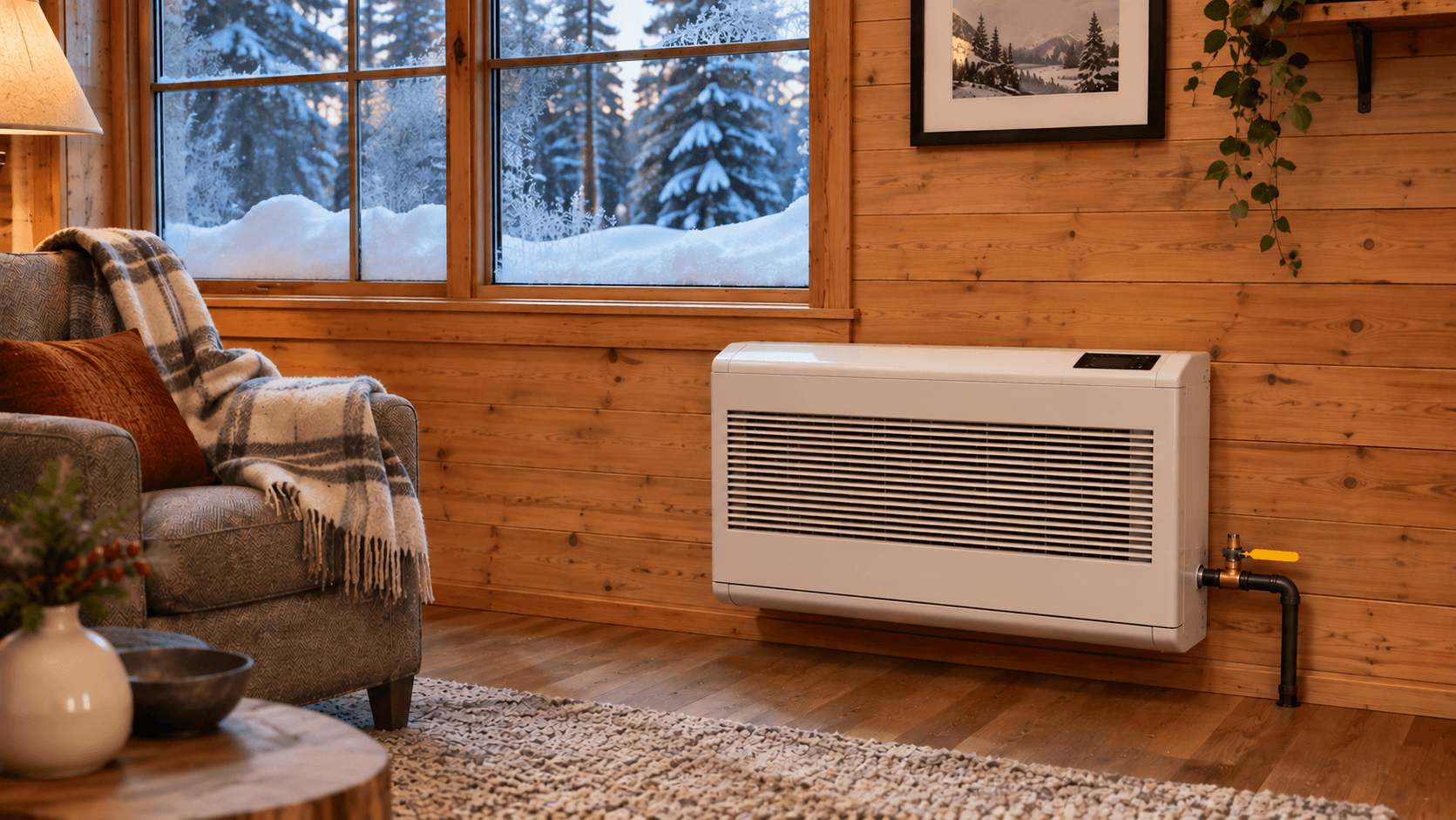
A direct-vent wall furnace heats the space it sits in by drawing outside air for combustion and exhausting combustion gases back through the wall. Size it from a heat-loss calculation performed to ACCA Manual J, not a square-foot chart. Then select a model whose output matches that load using ACCA Manual S. In a cold climate, also decide before you buy whether the furnace must keep heating when the power goes out. Those two decisions, load-based sizing and outage behavior, separate a well-matched installation from one that falls short.
A direct-vent wall furnace is a self-contained heating appliance that mounts on or recesses into an exterior wall. It uses a sealed combustion chamber: according to Empire Comfort Systems, direct vent "uses outside air to support combustion" through a vent-within-a-vent passage built into the wall. No chimney is required, and no indoor air is consumed. For a fuller explanation of how the sealed-combustion system works, see our guide to how direct-vent gas heaters work.
A wall furnace is not the same as a ducted central furnace. A central furnace distributes heat through a duct system to every room in the house. A wall furnace heats the space it occupies and the adjacent areas that air movement reaches. It is also not a vent-free heater, which burns gas without any flue connection. This article covers direct-vent wall furnaces only and does not recommend vent-free models. For a comparison of the two venting approaches, see direct-vent vs vent-free heaters.
A direct-vent wall furnace is a good fit when it matches the job. It works well as the primary heat source for a single open zone, a small home or cabin, or a room that needs reliable supplemental heat. It is not the right tool for heating a multi-room layout through closed doors or for replacing a ducted system that serves many separate spaces. The question is not whether wall furnaces are good in the abstract; it is whether a specific model is correctly sized for the specific zone it will heat.
The honest answer depends entirely on the layout. A wall furnace heats the space it sits in and whatever air movement carries heat to adjacent areas. In an open-plan home or a small cabin where the living area, kitchen, and sleeping space share one connected volume, a single well-placed unit can heat the whole interior effectively. The air circulates freely, and the furnace responds to the thermostat reading of that shared space.
Closed-off rooms are a different matter. A bedroom behind a closed door, a bathroom at the end of a hallway, or a utility room separated by a wall will receive little or none of the heat the furnace produces. The furnace is not undersized in those cases; the layout is simply not open enough for one unit to serve every room.
The relevant question is not how many square feet the home contains. It is how freely air moves between the furnace's location and every space that needs heat. A compact home with an open floor plan may be well served by one unit. A home of similar size with a closed hallway and separate bedrooms may need a second unit in the sleeping wing.
How many units a home needs, and where each one goes, is a design decision the installer makes after calculating the heating load for each zone. One unit per zone is the standard approach. The installer determines the zone boundaries from the layout and the load calculation, not from a general coverage claim.
The most common sizing mistake is using a square-foot chart or a broad BTU-per-square-foot rule to choose a furnace. Those rules exist because they are easy to apply. They are not reliable, especially in cold climates, because they ignore the variables that actually determine how much heat a space loses.
The correct starting point is a heat-loss calculation. ACCA Manual J is "the national ANSI-recognized standard for producing HVAC equipment sizing loads" for single-family homes, small multi-unit buildings, townhouses, and manufactured homes. A Manual J calculation is "required by national building codes and most state and local jurisdictions," according to ACCA.
Manual J accounts for the actual conditions of the home, not a generic average. ENERGY STAR's HVAC Quality Installation guidance is direct on this point: size from "the actual characteristics of your home" and "do not just rely on a 'rule of thumb.'" The same guidance warns that oversized equipment "may cycle too frequently, resulting in less comfort and a shortened lifespan."
A square-foot chart cannot account for the factors ENERGY STAR identifies as the basis for proper sizing: the size of the house, the level of insulation, and windows.
In a cold climate, the gap between a square-foot estimate and the actual heat loss can be substantial. A well-insulated newer cabin and a drafty older home of identical footprints can have very different heating loads. A rule-of-thumb figure treats them the same. A Manual J calculation does not.
Once the heat-loss calculation is complete, the next step is equipment selection. Manual S (ANSI/ACCA 3, "Residential Equipment Selection") is ACCA's guide for selecting and sizing residential heating equipment from the home's heating load and the manufacturer's performance data. Its size limits account for regional outdoor conditions to prevent short cycling. Manual J establishes the load; Manual S guides the equipment choice from that load. A qualified installer works through both steps before recommending a model.
Every gas wall furnace carries a BTU rating on its label. That number is an input rating: it measures how much fuel the burner consumes per hour, not how much heat reaches the room. Some of that energy leaves through the vent as part of the combustion process. The heat actually delivered to the space is lower than the input figure. When your installer gives you a heat-loss number for a zone, compare it to the manufacturer's stated output or efficiency data, not the raw input rating. The same input rating tells you how much fuel the furnace can burn: our guide to how much propane a heater uses converts it to gallons per hour, per day and per tank.
Rinnai EnergySaver wall furnaces use a modulating gas valve with a variable-speed blower. According to Rinnai, this combination "uses only the gas needed to heat the space." The furnace does not run at full input whenever it fires; it adjusts its output to match the current demand. That matters most in shoulder seasons, when the outdoor temperature is mild and a full-output burst would overshoot the thermostat and short-cycle. A wide modulating range gives the furnace more room to match its output to actual conditions.
The table below shows the BTU input range for each Rinnai EnergySaver propane model, from minimum to maximum, as published by Rinnai on rinnai.us. Natural gas versions are also available for every model.
|
Model |
BTU Input Range (Propane) |
|---|---|
|
3,000 to 8,000 |
|
|
5,700 to 11,000 |
|
|
8,700 to 16,700 |
|
|
8,200 to 20,700 |
|
|
13,200 to 36,500 |
Empire direct-vent wall furnaces operate at a fixed input. The DV210SGX has a 10,000 BTU input. The DV25SG has a 24,000 BTU propane input (25,000 BTU natural gas). The DV35SG has a 35,000 BTU input. Because these models run at a single output level, matching them to the zone's heat-loss figure is especially important. A fixed-input furnace that is too large for the zone will short-cycle; one that is too small will run continuously without reaching the thermostat setpoint.
Consider a hypothetical example only, not a claim about any real home. Suppose an installer calculates a heat-loss figure for a zone and determines the zone needs a furnace whose output covers that load at the rated efficiency. The installer then consults the manufacturer's performance data and Manual S to identify which model's output range, at the appropriate efficiency, matches the calculated load without exceeding the size limits that prevent short cycling. That process, not a square-foot rule, is how a model is matched to a zone.
Every Rinnai EnergySaver wall furnace is available in both a natural gas version and a propane version. The Empire DV25SG is available in both versions (24,000 BTU propane / 25,000 BTU natural gas input). Order the version that matches the fuel supply at the installation address. The two versions are not interchangeable in the field; a propane model is factory-set for propane pressure and orifice sizing, and a natural gas model is set for natural gas.
If a conversion is ever needed, that work must follow the manufacturer's instructions exactly and be performed by a licensed gas or propane technician. Do not attempt a fuel conversion without the manufacturer's instructions and a qualified installer.
For guidance on using propane appliances safely indoors, including ventilation practices and carbon monoxide awareness, see our article on using a propane heater indoors.
For rural and off-grid homes, power outage behavior is not a footnote. It is one of the first questions to answer, because the two product families on this page behave differently when the grid goes down, and that difference can determine which model is right for a given installation.
Rinnai EnergySaver wall furnaces require electricity to operate. According to Rinnai, units "automatically shut down in the case of overheating, flame failure, power failure, or abnormal spark." A power outage means the furnace stops. In a location where grid power is reliable and outages are brief, this is rarely a problem. In a remote home where outages can last hours or days in deep cold, it is a critical limitation to plan around.
Empire DV-series wall furnaces are built differently. The Empire DV25SG and DV35SG use "matchless piezo ignition (heats without electricity)," according to Empire Comfort Systems. The wall thermostat for these models "requires no electricity." When the power goes out, an Empire DV furnace continues to heat the zone it serves.
That is a meaningful distinction for a cabin, a remote property, or any home where sustained heat during a multi-day outage is a safety requirement. The Empire models do not need a generator, a battery backup, or any workaround. They use a millivolt (thermopile) system, according to the Empire installer manual.
Key decision point: If the home must maintain heat during a power outage without a generator, an Empire DV-series wall furnace is the option among the models on this page that supports that. If grid power is available and reliable, the Rinnai's modulating output and variable-speed blower offer different advantages.
For a broader look at heating options that work without electricity, including other non-electric models, see our guide to non-electric heaters for areas without power access.
Two installation variables that affect performance in cold-climate and mountain locations deserve attention before you order: altitude derating and the physical requirements for venting and placement.
Gas appliances produce less heat at elevation because thinner air delivers less oxygen to the burner. For the Empire DV25SG and DV35SG specifically, the Empire installer manual states that above 2,000 feet, input ratings are reduced 4 percent for each 1,000 feet above sea level. A home at 5,000 feet, for example, would see the rated input of those models reduced by 20 percent.
That derate applies to the Empire DV25SG and DV35SG only. For every other model on this page, check the manufacturer's installation manual for the altitude correction that applies to that specific unit. Do not apply the Empire figure to a Rinnai model or to the Empire DV210SGX.
The manufacturer's installation manual and a qualified installer set all venting and placement requirements for a direct-vent wall furnace. This includes vent termination location, clearances to combustibles and openings, and any restrictions specific to the model. These requirements vary by model and by local code. No general figures for vent length, wall thickness, or clearance distances are given here, because applying a figure from one model's manual to a different model or installation can create a safety hazard.
Rinnai recommends professional installation for all EnergySaver models. The Empire DV-25/35 installer manual requires inspection at least annually by a qualified service person. For ongoing maintenance guidance, see our gas heater maintenance guide.
The table below compares the models Rural Energy carries, built only from manufacturer-published data. No model is ranked, and no model is recommended over another in the abstract. The right choice depends on the zone's heat-loss figure, the fuel available, the elevation, and whether the home needs heat during a power outage.
|
Model |
BTU Input |
Fuel |
Needs Electricity |
Modulating |
|---|---|---|---|---|
|
3,000 to 8,000 |
Propane or natural gas |
Yes |
Yes |
|
|
5,700 to 11,000 |
Propane or natural gas |
Yes |
Yes |
|
|
8,700 to 16,700 |
Propane or natural gas |
Yes |
Yes |
|
|
8,200 to 20,700 |
Propane or natural gas |
Yes |
Yes |
|
|
13,200 to 36,500 |
Propane or natural gas |
Yes |
Yes |
|
|
10,000 (fixed) |
See product page |
No |
No |
|
|
24,000 LP / 25,000 NG (fixed) |
Propane or natural gas |
No |
No |
|
|
35,000 (fixed) |
Propane or natural gas |
No |
No |
For a detailed comparison of Rinnai and Toyotomi models in Alaska conditions, see our Toyotomi vs Rinnai guide. For the full Rinnai product range, including water heaters and other heating equipment, see the Rinnai brand page.
A single wall furnace is not always the complete answer. Three situations call for a second unit, a backup, or a different system altogether.
As covered earlier, a wall furnace heats the zone it occupies. A sleeping wing separated from the main living area by a hallway and closed doors is a separate zone. If that zone needs reliable heat, it needs its own unit sized to its own load. The installer determines zone boundaries from the layout and the heat-loss calculations for each space.
If the primary furnace is a Rinnai model and the home is in a location where extended outages are possible, a non-electric backup heater in a critical space can prevent pipes from freezing and maintain livable conditions. An Empire DV-series unit in a key room serves that purpose without requiring a generator. For more options, see the guide to non-electric heaters for areas without power access.
If the home already has an oil heating system and a wall furnace is being considered as a supplement or replacement, the sizing and equipment considerations are different. See our direct-vent oil furnaces guide for guidance on oil-fired direct-vent heating.
If the heat-loss calculation for a zone produces a load that exceeds the output of the largest available wall furnace, the installer may recommend a different system type, a ducted central furnace, or multiple wall furnaces serving sub-zones. That determination comes from the load calculation, not from a general rule about home size.
Rural Energy helps customers choose and size a wall furnace before they order. To get a recommendation, have the following ready:
Rural Energy does not install or repair equipment. Customers rely on a local licensed gas or propane technician for installation and service. Rural Energy's role is helping you identify the right model and get it to your door. The company ships across the United States and to Canada.
Browse the full range of direct-vent gas wall furnaces or reach the team directly:
A. Yes, a direct-vent propane wall furnace can run continuously, including overnight. Because it uses a sealed combustion chamber that draws outside air and vents exhaust back through the wall via a vent-within-a-vent passage, it does not consume indoor air or introduce combustion gases into the living space during normal operation. Follow the manufacturer's instructions for thermostat settings and safe operation. For guidance on carbon monoxide awareness and general propane appliance safety indoors, see our article on using a propane heater indoors. Do not leave any heating appliance running unattended without functioning carbon monoxide and smoke detectors in the home.
A. Rinnai EnergySaver wall furnaces use a modulating gas valve that adjusts output to match demand. Check the installation manual for the specific model to confirm what thermostat or control options are available and required for that unit. Empire DV25SG and DV35SG models include a wall thermostat that requires no electricity, which is part of what allows those units to operate during a power outage. If you are comparing control options across models, Rural Energy's technical support team can clarify what each model includes and what accessories are available. Reach them at (907) 868-7952.
A. A Rinnai EnergySaver wall furnace requires electricity to operate, so it can run on a generator if the generator supplies the correct voltage and the furnace's electrical requirements are met. Sizing the generator correctly for the furnace's electrical load is a question for a licensed electrician or the installer. Empire DV25SG and DV35SG models use matchless piezo ignition and a non-electric wall thermostat, so they heat without electricity and do not need a generator at all. If outage operation without a generator is a priority, the Empire DV-series is the option among the models on this page that supports that without any additional equipment.
A. The smallest model Rural Energy carries is the Rinnai EX08, with a BTU input range of 3,000 to 8,000 for the propane version. The Empire DV210SGX has a fixed 10,000 BTU input. Choosing the smallest available model is not the same as choosing the correctly sized model. Even for a small bedroom or cabin, the right starting point is a heat-loss calculation for that specific space. A unit that is too small will run continuously and never reach the thermostat setpoint; a unit that is too large will short-cycle. Size from the load, not from the model number.
A. Yes, but the rated input decreases at elevation because thinner air delivers less oxygen to the burner. For the Empire DV25SG and DV35SG, the Empire installer manual specifies a reduction of 4 percent of rated input for each 1,000 feet above sea level, once the home is above 2,000 feet. That derate applies to those two models only. For the Rinnai EnergySaver models and the Empire DV210SGX, consult the installation manual for that specific unit to find the altitude correction that applies. Do not apply the Empire DV25/35 figure to other models. If the property is above 2,000 feet, have the elevation ready when you contact Rural Energy so the team can factor it into the recommendation.
A. Every Rinnai EnergySaver model and the Empire DV25SG come in both natural gas and propane versions. The correct approach is to order the version that matches the fuel supply at the installation address. If a conversion is ever needed after installation, it must be performed strictly according to the manufacturer's documented conversion instructions, by a licensed gas or propane technician. Attempting a fuel conversion without the manufacturer's instructions or a qualified installer creates a serious safety hazard. Rural Energy can confirm which fuel version is available for a given model. Contact sales at (907) 278-7441.
A. No. A direct-vent wall furnace does not require a chimney. It uses a vent-within-a-vent passage that passes through the exterior wall. The entire combustion process is sealed from the living space. Because the vent terminates at the exterior wall rather than rising through the roof, a direct-vent wall furnace can be installed in homes and cabins that have no chimney. The specific venting requirements, including where the vent may terminate and what clearances are required, are set by the manufacturer's installation manual and a qualified installer.
A. The Empire DV-25/35 installer manual requires inspection at least annually by a qualified service person. For other models, follow the maintenance schedule in the specific unit's installation manual. For general gas heater maintenance guidance, see our gas heater maintenance guide. Rural Energy does not perform installation or service; customers rely on a local licensed technician.
A. The cost of any heating installation depends on several factors. What drives the cost difference between a wall furnace installation and a ducted central furnace installation is primarily the absence of ductwork. A direct-vent wall furnace requires a vent passage through the exterior wall, a gas line connection, and in the case of electric-ignition models, an electrical connection. A ducted central furnace requires all of that plus a full duct system throughout the home. The gas line, venting configuration, local labor rates, and any required permits are the variables a licensed installer can price for a specific property. Rural Energy does not install equipment.
A. An oversized wall furnace short-cycles: it reaches the thermostat setpoint quickly, shuts off, then fires again before the space has cooled evenly. ENERGY STAR's HVAC Quality Installation guidance states that oversized equipment "may cycle too frequently, resulting in less comfort and a shortened lifespan." The fix is correct sizing from a heat-loss calculation, not a square-foot estimate. ENERGY STAR's 10 Tips for Hiring a Heating and Cooling Contractor is explicit: "A bigger system isn't always better" and sizing should be based on "the size of your house, level of insulation, and windows," not a rule of thumb.