
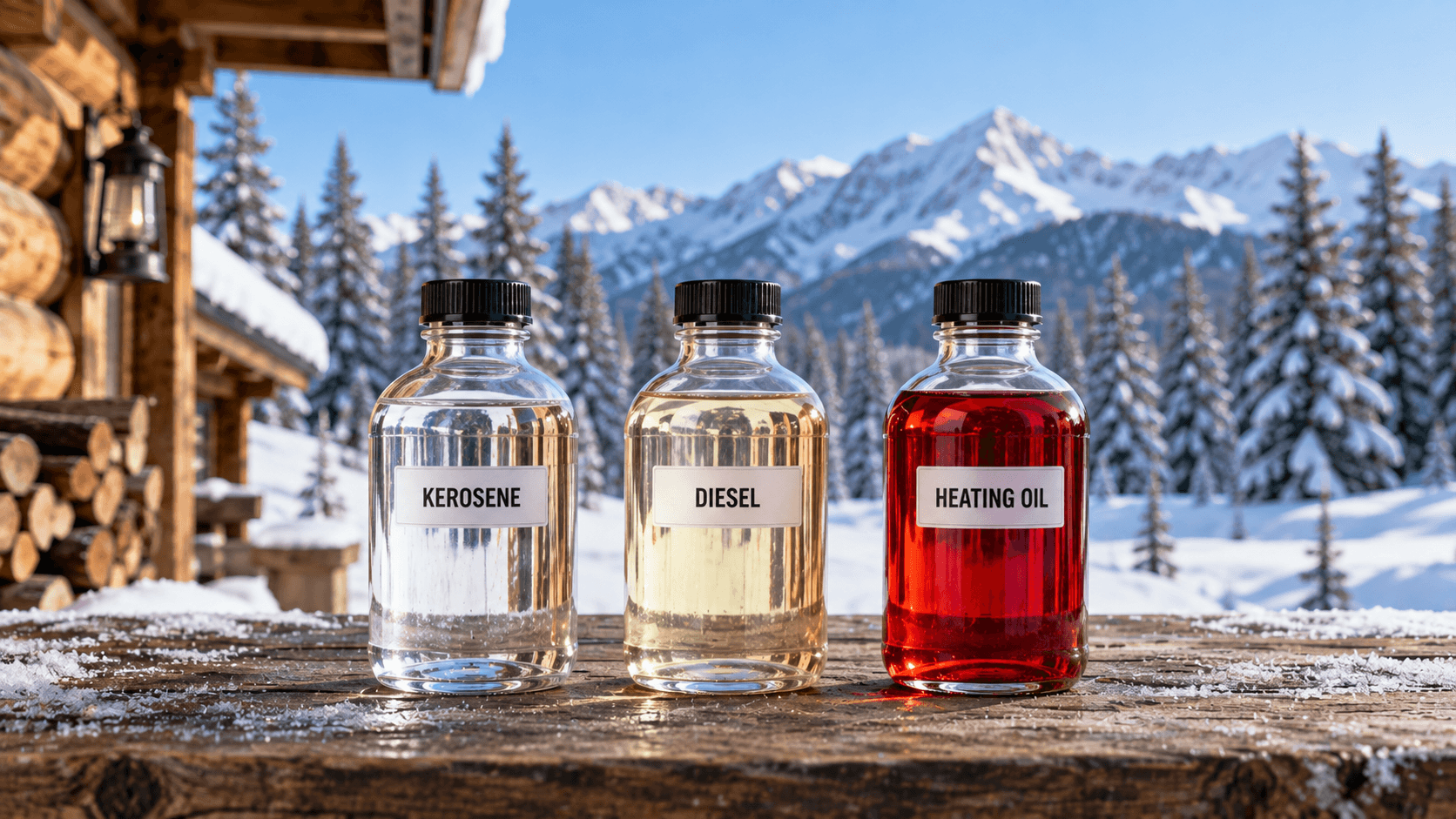
Kerosene, heating oil and diesel are all distillates and close cousins, but they are not interchangeable in every heater. The only authority on which fuel belongs in a given unit is the manufacturer's approved-fuel list. K-1 kerosene and #1 fuel oil are the light grades; #2 fuel oil and diesel are heavier and behave differently in cold weather. Gasoline is never acceptable in any heater covered here.
K-1 kerosene is governed by ASTM D3699, which sets a maximum sulfur content of 0.04 percent by mass for No. 1-K. K-1 and 1-K are two names for the same grade. It is the grade the U.S. Consumer Product Safety Commission specifies for unvented wick heaters: "Use only water-clear 1-K grade kerosene."
Also defined by ASTM D3699, No. 2-K carries a much higher sulfur maximum of 0.30 percent. The CPSC warns that "grades other than 1-K can lead to a release of more pollutants in your home," so 2-K does not belong in an unvented wick heater. None of the heaters covered here lists 2-K by name.
No. 1 fuel oil is defined by ASTM D396, the standard for fuel oils burned in heating equipment. It is the lighter of the two common heating-oil grades and stays fluid far colder than No. 2. The Toyotomi Laser's approved-fuel list names it as "Low Sulfur No. 1 Fuel (ASTM D396 S500)", where S500 means 500 parts per million of sulfur at most.
No. 2 fuel oil, commonly called "home heating oil," is also governed by ASTM D396. It is heavier than No. 1 and begins to congeal at around 20°F, according to a rule of thumb from the University of Alaska Fairbanks Cooperative Extension. Some heaters list it and some do not: the Toyotomi OM-122DW and OM-128HH accept it, the Toyotomi Laser does not.
Ultra low sulfur means 15 parts per million of sulfur or less. The U.S. Energy Information Administration notes that New York was the first state to require ultra low sulfur heating oil, in 2012. Toyotomi lists both ULSHO and ULSD under ASTM D975 S15, the diesel standard's 15 ppm grade, so on a fuel ticket S15 is the mark to look for. These grades are approved for the heaters that list them, but they behave differently from No. 1 in deep cold.
Heating oil is dyed red. The EIA explains that the IRS requires heating oil and other distillate fuels that are not for highway use to be colored red, and that the color identifies the fuel as exempt from highway fuel taxes. Red-dyed fuel is illegal to use in road vehicles. For heater compatibility, the color tells you nothing; the grade and the sulfur content are what matter.
Four standards cover every fuel discussed here:
Kerosene is defined by ASTM D3699.
Heating fuel oils, including the biodiesel-blend grades, are defined by ASTM D396.
Diesel is defined by ASTM D975.
Jet fuel (Jet A and Jet A-1) is defined by ASTM D1655 as "aviation turbine fuel," a separate specification from heating kerosene. No heater that Rural Energy sells lists jet fuel as an approved fuel.
The EIA describes heating oil and diesel fuel as "closely related petroleum products called distillates." Heating oil is sold mainly for furnaces, boilers and water heaters. What separates the two in practice is sulfur content, dye and tax treatment, and the specific grade.
Red-dyed heating oil is legal for home heating and illegal in road vehicles. Under IRS Publication 510, home heating is a nontaxable use, and using dyed fuel for a taxable use carries a penalty of the greater of $1,000 or $10 per gallon.
For heater compatibility, the grade matters more than the color. A heater approved for ULSD or ULSHO (ASTM D975 S15) accepts that grade whether it is sold clear for road use or dyed for heating. A heater approved only for No. 1 fuel oil (ASTM D396 S500) is not automatically approved for No. 2, even if both arrive in the same red-dyed delivery truck from the same dealer.
|
Fuel |
Standard |
Sulfur limit |
Cold behavior |
Heaters covered here that list it |
|---|---|---|---|---|
|
K-1 (1-K) kerosene |
ASTM D3699 |
0.04% max |
Light grade; NordicStove names it, with #1, for colder conditions |
Unvented wick heaters (1-K only), Toyotomi Laser, Toyotomi OM-122DW and OM-128HH, NordicStove, Monitor (per data plate) |
|
2-K kerosene |
ASTM D3699 |
0.30% max |
Not stated in the sources used here |
None of the heaters covered here; not for unvented wick heaters |
|
No. 1 fuel oil |
ASTM D396 |
S500 grade: 500 ppm max |
Flows to about -60°F (UAF rule of thumb) |
Toyotomi Laser (low sulfur S500), Toyotomi OM-122DW and OM-128HH, NordicStove (factory setting), Monitor (per data plate) |
|
No. 2 fuel oil (home heating oil) |
ASTM D396 |
Depends on the sulfur grade purchased |
Begins to congeal around 20°F (UAF rule of thumb) |
Toyotomi OM-122DW and OM-128HH, NordicStove (may burn poorly on low), Monitor (per data plate). Not the Toyotomi Laser |
|
ULSD / ULSHO |
ASTM D975 S15 |
15 ppm max |
Gets worse at 21°F and below and can gel (Toyotomi) |
Toyotomi Laser, Toyotomi OM-122DW and OM-128HH |
|
Automotive or marine diesel |
Automotive: ASTM D975 (U.S.), EN 590 (Europe) |
Depends on grade |
Depends on the seasonal grade sold |
NordicStove (warm conditions). Autoterm: EN 590 diesel only. Clear ULSD meeting ASTM D975 S15 is on the Toyotomi Laser and OM lists; marine diesel is not |
For a heater-by-heater comparison organized by appliance type rather than by fuel, see the direct vent oil furnace guide and its "Three Kinds of Fuel Oil Heat" table.
The manufacturer's approved-fuel list is the only authority. "It's all diesel" is not a safe assumption. The table below is drawn from the product specifications and manuals as of October 14, 2026.
|
Heater |
Approved fuels, from the manufacturer |
Not listed |
|---|---|---|
|
Toyotomi Laser 303/304, 531/532 and 731/732 (direct vent) |
"Ultra Low Sulfur Heating Oil (ULSHO) or Ultra Low Sulfur Diesel Fuel (ULSD) (ASTM D975 S15), Low Sulfur No. 1 Fuel (ASTM D396 S500), or K-1 Kerosene (ASTM D3699)", usable "without any modifications to the unit" |
#2 fuel oil, biodiesel, gasoline |
|
Toyotomi OM-122DW water heater and OM-128HH hydronic heater |
ASTM D396 No. 2 fuel oil (home heating oil); ASTM D396 No. 1 low sulfur fuel oil; ASTM D975 ultra low sulfur heating oil or diesel; ASTM D3699 K1 kerosene |
Biodiesel, gasoline |
|
NordicStove oil drip stoves (all sizes) |
Factory pre-set for #1; can use "marine diesel, #2 heating oil, or automotive diesel as needed (with adjustments)." The NordicStove Operating Instructions say the regulator is "calibrated for light grade #1 heating oil," that "#2 oil can be used but heat output values may be slightly lower and the unit may not burn properly in the low range," and that "in colder conditions, number one heating oil or kerosene will give better performance" |
Biofuel is not listed |
|
Autoterm Air 2D and Air 4D diesel air heaters |
"Use only diesel fuel standard EN590, depending on the ambient temperature." |
Biofuel is prohibited: "Do not operate the heater using biofuel." Kerosene and heating oil are not listed |
|
Unvented wick kerosene heaters (general; not sold by Rural Energy) |
The CPSC: "Use only water-clear 1-K grade kerosene." |
Every other grade, including diesel and #2 |
|
Monitor heaters (discontinued) |
The fuel is printed on the unit's data plate: K-1 kerosene, or No. 1 or No. 2 fuel oil. The Monitor heater guide explains how to read it |
Depends on the model |
Every Toyotomi Laser also needs 120 V power, whichever approved fuel it burns. Rural Energy sells heaters, tanks and fuel-system parts; it does not sell fuel and does not install. For help matching a heater to the fuel available where you live, reach the team by phone or email.
The sources support these points, heater by heater:
Unvented wick heaters and any grade other than 1-K: the CPSC warns that other grades "can lead to a release of more pollutants in your home." Use 1-K only.
ULSD in a Toyotomi Laser: ULSD is approved, but Toyotomi says to service the heater at least every two years when using it, "because the distillation of ULSD is heavier than 1-K Kerosene and No. 1 Fuel Oil."
#2 fuel oil in a Toyotomi Laser: #2 is not on the Laser's approved-fuel list. That is the whole answer, and the reason to choose a different heater if #2 is the only fuel you can get.
Gasoline: Toyotomi's Laser manuals say never to use gasoline, alcohol, white gas, camp stove fuel or additives.
Biofuel in an Autoterm: the Autoterm manual prohibits it.
Additives: Toyotomi allows one exception to its no-additives rule, an anti-gel additive for ULSD in cold weather, chosen with the fuel supplier.
If the wrong fuel is already in the tank, stop the heater, do not restart it, and call a qualified service technician before running it again. The heater manufacturer or a trained technician, not a general guide, is the right judge of what a particular mix-up requires.
ASTM D975 calls combining Grades No. 1 and No. 2 "permitted and normal blending practice" when a low cold-weather cloud point is needed. The University of Alaska Fairbanks Cooperative Extension adds a caution: mixing the two grades helps, but it "does not guarantee adequate fuel flow when the temperature plummets." Blending is a practical tool, not a guarantee.
When a new heater does not list the fuel already in the tank, for example a Toyotomi Laser going onto a tank of #2, that fuel is not an approved fuel for the new heater, blended or not. Plan the changeover with your fuel supplier and a service technician before the new heater is connected, so the first fill it sees is a grade on its list.
The NordicStove manual adds a point worth knowing for any heater: fuels sold under the same name, such as "#1 stove oil" or "#2 diesel," can differ significantly in viscosity from one delivery to the next, and "some fuels contain additives that may leave residue in the burner and regulator." That is a reason to buy from a consistent supplier and to know which grade you are ordering.
If a heater's approved list includes more than one grade, as the Toyotomi Laser's does with K-1 kerosene, No. 1 fuel oil and ULSD, topping up with another grade from that same list keeps you inside the manufacturer's guidance. Topping up with a grade that is not on the list does not. Check the list before adding anything.
Cold weather is where the difference between grades stops being academic.
According to the University of Alaska Fairbanks Cooperative Extension, #2 fuel oil begins to congeal at around 20°F, while #1 fuel oil keeps flowing to roughly -60°F. Treat both as rules of thumb, not specification values.
Toyotomi notes that ULSD "becomes worse at temperatures of 21°F (-6°C) and below and can 'gel'", which can cause ignition failure, and recommends an anti-gel additive chosen with the fuel supplier. That is the one additive Toyotomi permits.
Our recommendation for a Toyotomi Laser in deep cold, or with an outdoor tank: K-1 kerosene or #1 fuel oil. ULSD remains an approved option, with the anti-gel additive and the two-year service interval.
The NordicStove manual points the same way: number one heating oil or kerosene for colder conditions, with #2 or diesel acceptable in warm conditions.
How stored fuel holds up through a winter is a separate question, covered in Does Kerosene Go Bad? Storing Heating Fuel. The direct vent oil furnace guide has a "Fuel Grade in Deep Cold" section for furnace buyers.
Bioheat is heating oil blended with biodiesel. ASTM D396 has included a grade for blends of 6 to 20 percent biodiesel (B6 to B20) since 2015, and the April 2026 revision, ASTM D396-26a, added grades for blends of 21 to 50 percent biodiesel, according to the National Energy and Fuels Institute and Clean Fuels Alliance America. A grade existing in the standard does not mean any particular heater is approved to burn it. That approval comes from the heater's manufacturer, not from the fuel standard.
Toyotomi Laser and OM series: biodiesel is not on either approved-fuel list.
Autoterm Air 2D and 4D: the manual prohibits biofuel.
NordicStove: biofuel is not among the listed fuels.
If a supplier offers a Bioheat blend, confirm with the heater's manufacturer before filling. Rural Energy does not sell fuel and cannot approve a fuel on a manufacturer's behalf.
Running low on fuel at a rural or remote property is a real scenario. Work through it in this order:
Check the approved-fuel list first. If your heater accepts more than one grade, you have options. The Toyotomi Laser accepts K-1 kerosene, No. 1 fuel oil, ULSD and ULSHO. The Toyotomi OM-122DW and OM-128HH accept all of those plus No. 2 fuel oil. A NordicStove is set for #1 and can burn #2, automotive diesel or marine diesel, though #2 may burn poorly on the low setting, and the manufacturer recommends a qualified technician for any regulator adjustment.
Substitute only within the approved list. If your Laser runs on No. 1 and the dealer has ULSD, that is a listed fuel. If the dealer only has #2, that is not on the Laser's list. Do not use it.
Never use gasoline. Toyotomi's manuals forbid it outright, and no heater covered here lists it.
For an Autoterm: the manual calls for EN590 diesel, "depending on the ambient temperature," so buy the diesel grade sold locally for the season. Do not substitute kerosene, heating oil or biofuel.
If no approved fuel is available: shut the heater down and call Rural Energy or a local service technician. Running a heater on a fuel its manufacturer does not list is outside the manufacturer's guidance.
Matching the heater to the fuel is easier before a cold night than during one.
Fuel availability varies from one rural or remote area to the next. Choosing a heater that lists the fuel you can actually buy matters as much as choosing the right heat output.
Rural Energy's oil heaters include direct vent oil furnaces, the NordicStove oil drip stoves (see the NordicStove oil heater guide), non-electric oil heaters and the Autoterm diesel air heaters. For Toyotomi fuel systems there are replacement parts such as the Toyotomi fuel filter element and the fuel filter and fittings kit.
Rural Energy helps match the heater to the fuel you can actually get where you live, by phone or email. Contact the team before you buy.
A. No, #2 heating oil is not on the Toyotomi Laser's approved-fuel list. Toyotomi approves three fuels for the Laser 303/304, 531/532 and 731/732: ultra low sulfur heating oil or ultra low sulfur diesel (ASTM D975 S15), low sulfur No. 1 fuel oil (ASTM D396 S500) and K-1 kerosene (ASTM D3699), all usable "without any modifications to the unit." #2 is not one of them. If your dealer only delivers #2, ask whether they also carry No. 1 fuel oil or ULSD, since either keeps a Laser on its list. If #2 is genuinely the only fuel you can buy, choose a heater that lists it: the Toyotomi OM-122DW and OM-128HH both accept ASTM D396 No. 2 fuel oil, and a NordicStove can burn it too. Rural Energy can help you compare the options by phone or email.
A. No, jet fuel is not heating kerosene, and no heater Rural Energy sells lists it as an approved fuel. Jet A and Jet A-1 are defined by ASTM D1655 as aviation turbine fuel, a specification written for aircraft engines and for the agencies that buy fuel for them. K-1 heating kerosene is defined by a different standard, ASTM D3699. Two fuels that share a family name are not interchangeable just because both are kerosene-type. The Toyotomi Laser and OM heaters list K-1 kerosene, No. 1 fuel oil and ultra low sulfur heating oil or diesel; the OM units add #2; the NordicStove lists #1, #2 and diesel; the Autoterm lists only EN590 diesel. Jet fuel appears on none of those lists. If aviation fuel is the only fuel within reach, do not put it in a heater; call the heater's manufacturer or a service technician first.
A. No, the Autoterm manual calls for diesel only, so kerosene is outside its guidance. The installation manual for the Autoterm Air 2D and Air 4D says: "Use only diesel fuel standard EN590, depending on the ambient temperature." EN 590 is the European standard for automotive diesel. Kerosene and heating oil are not mentioned as acceptable alternatives, and the same manual is explicit about one more fuel: "Do not operate the heater using biofuel." The phrase "depending on the ambient temperature" matters in a cold climate, because diesel is sold in seasonal grades. The practical reading is to buy the diesel grade sold locally for the season you are in. If you are not sure which grade your supplier is selling, ask before you fill. The Autoterm 2D and 4D product pages link the full manuals.
A. No, red-dyed fuel is illegal to use in vehicles that are driven on public roads. The U.S. Energy Information Administration explains that the IRS requires heating oil and other distillate fuels that are not for highway use to be dyed red, and that the dye marks the fuel as exempt from highway fuel taxes. Burning that same dyed fuel in a home heater is legal: IRS Publication 510 lists home heating among the nontaxable uses of diesel fuel and kerosene. Putting it in a highway vehicle is a taxable use, and the IRS penalty for using dyed fuel that way is the greater of $1,000 or $10 per gallon. The rule turns on where the fuel is used, not on who sold it. Keep dyed fuel for heating equipment and buy clear, taxed fuel for anything that drives on the road.
A. Yes, on the published limits K-1 kerosene allows less sulfur than the low sulfur No. 1 fuel oil a Toyotomi Laser lists. The kerosene standard, ASTM D3699, caps No. 1-K at 0.04 percent sulfur by mass, which works out to 400 parts per million. The Laser's approved No. 1 fuel is the ASTM D396 S500 grade, which allows up to 500 parts per million. Both are maximums, so a given delivery can come in lower. Sulfur matters most where exhaust stays in the room: the U.S. Consumer Product Safety Commission tells owners of unvented wick heaters to use only water-clear 1-K kerosene, because other grades can release more pollutants indoors. A vented heater such as the Toyotomi Laser lists both fuels, so either is acceptable there. Ultra low sulfur grades sit lower still, at 15 parts per million.
A. It depends on the heater: a Toyotomi Laser can switch between its listed fuels with no changes, while a NordicStove may need its regulator adjusted. For the Laser, Toyotomi states that ULSHO, ULSD, low sulfur No. 1 fuel oil and K-1 kerosene are all usable "without any modifications to the unit," so moving from No. 1 to K-1 is simply a change of fuel. The OM-122DW and OM-128HH carry the same four fuels plus #2 on their lists. A NordicStove is factory calibrated "for light grade #1 heating oil," and its manual names kerosene alongside #1 for colder conditions. Moving to a heavier grade is where the regulator may need adjusting, and the manufacturer recommends a qualified technician for that work, warning that incorrect fuel flow adjustment can create a fire hazard. Whatever the heater, check its approved list before the first fill of a new grade.
A. The "S" stands for sulfur, and the number is the maximum sulfur content in parts per million. S15 means no more than 15 parts per million, the ultra low sulfur grade. Toyotomi lists ultra low sulfur heating oil and ultra low sulfur diesel for the Laser as "ASTM D975 S15." S500 means no more than 500 parts per million; the Laser's approved No. 1 fuel is "Low Sulfur No. 1 Fuel (ASTM D396 S500)." The designation is how you confirm that a delivery matches the fuel your heater's list names, because the color of the fuel tells you nothing about its grade. If your ticket shows a fuel name but no sulfur grade, ask the supplier for the full specification before the fuel goes into the tank. Keep your heater's approved list with your fuel records for exactly this check.
A. Yes, the NordicStove manual itself describes using heavier fuels in warm weather and lighter fuels in cold weather. The Operating Instructions say that "in warm conditions number-two heating oil, automotive grade diesel fuel, or marine grade diesel fuel may be acceptable," while "in colder conditions, number one heating oil or kerosene will give better performance." The stove leaves the factory calibrated for #1, and the manual notes that #2 "can be used but heat output values may be slightly lower and the unit may not burn properly in the low range." If you decide to adjust the regulator for the heavier grade, the manufacturer recommends hiring a qualified technician, warns that incorrect fuel flow adjustment can create a fire hazard, and states that warranty coverage is void if the unit is over-fired. Plan any seasonal change with a technician rather than between deliveries. NordicStove details are on the brand page.
A. Your options are to find an approved fuel from another supplier or to choose a heater that lists #2, because #2 is not on the Laser's approved-fuel list. The Laser accepts K-1 kerosene (ASTM D3699), low sulfur No. 1 fuel oil (ASTM D396 S500), and ultra low sulfur heating oil or diesel (ASTM D975 S15). Start by asking your dealer whether they carry No. 1 fuel oil or ULSD alongside #2, and check whether another supplier in your area delivers one of the approved grades. If none does, the Laser is the wrong heater for that property. The Toyotomi OM-122DW and OM-128HH list ASTM D396 No. 2 fuel oil, and a NordicStove can burn #2, though it may burn poorly on its low setting. Rural Energy can help you weigh those options before you buy: reach the team through the contact page.
A. The NordicStove manual does not address mixing kerosene and diesel, so the safest course is to stay within one listed fuel at a time. What the manual does say is that the stove is calibrated for #1, that kerosene or #1 performs better in cold conditions, and that #2 or automotive or marine diesel may be acceptable in warm conditions. It also warns that fuels sold under the same name can differ significantly in viscosity between deliveries, and that some fuels contain additives that may leave residue in the burner and regulator. For heating oils and diesel, ASTM D975 treats blending Grades No. 1 and No. 2 as normal practice, but that describes how fuel is produced, not how a particular stove is approved. If a mixed tank is unavoidable, have a qualified technician confirm the regulator setting before relying on the stove for heat.