
Yes, kerosene and heating oil do go bad, but not on a fixed schedule. The real question is not how many years old the fuel is; it is whether the fuel is still fit to burn in your specific heater. Those are two different things.
Toyotomi oil heater manuals list storing fuel "for longer than six months" among things never to do, and say: "Begin each heating season with fresh fuel; discard at the end of season." That is far more conservative than anything circulating as general internet advice, and it exists for a reason. Fuel that can still ignite is not necessarily fuel that will burn cleanly, protect your burner, or keep your heater running through a cold-climate winter.
This guide covers how fuel actually degrades, what the warning signs look like, how to store fuel safely through summer and winter, and what to do when fuel has gone bad. All guidance is grounded in manufacturer manuals, published standards, and agency documents rather than generic estimates.
Who this applies to: Rural and off-grid homeowners, HVAC and plumbing contractors, facility managers in remote locations, and recreational property owners who depend on oil heaters to perform when conditions are worst.
Kerosene and heating oil do not expire the way food does. They degrade through a set of chemical and physical processes that accelerate depending on how the fuel is stored. Understanding those processes is the foundation for every storage and inspection decision that follows.
When fuel is exposed to oxygen over time, it oxidizes. This produces gum deposits and sediment. CRC Report 667, the Coordinating Research Council's reference document on diesel fuel quality, identifies gums as capable of clogging the small clearances in fuel system components, and particulate matter from degraded fuel as capable of plugging filters. Oxidation is not a sudden event; it is a slow process that accelerates with heat, light, and oxygen exposure.
Water enters storage tanks and containers through condensation, particularly when tanks are left partially empty through temperature swings. Once water is present, two distinct problems develop:
Dissolved water is suspended in the fuel and does not change how the fuel looks. CRC Report 667 notes that dissolved water alone does not make fuel visibly cloudy or hazy; only free water does that.
Free water settles to the bottom of the tank. It creates the conditions for microbial growth, including bacteria and fungi that produce sludge, biofilms, and acids that corrode tank walls and plug filters.
The distinction matters for inspection: a sample that looks clean is not necessarily free of water contamination.
All three accelerate degradation. Fuel stored in direct sunlight, in a warm location, or in containers that are not properly sealed degrades faster than fuel kept cool, dark, and sealed. This is why storage location matters as much as storage duration.
Key point: Fuel stabilizers, when added to fresh fuel shortly after purchase, can slow oxidation in bulk tanks. They cannot reverse degradation that has already occurred. Adding a stabilizer to old, discolored, or sour-smelling fuel does not make it safe to burn in a heater.
There is no single shelf life number published by any manufacturer or standards body that applies to all kerosene and heating oil in all conditions. Sources that state a universal figure are not citing a standard; they are generalizing from best-case scenarios that do not reflect how fuel actually behaves in a partially filled container sitting through an Alaska summer.
The most credible guidance comes from manufacturer manuals and established standards. The table below summarizes what authoritative sources actually say:
|
Source |
What it says |
|---|---|
|
Toyotomi oil heater manuals |
Storing fuel "for longer than six months" is listed among things never to do; "Begin each heating season with fresh fuel; discard at the end of season" |
|
ASTM D975 (diesel fuel oil standard) |
Storage beyond 12 months is classified as "long-term" and requires additional precautions; does not state a universal shelf life |
|
Focuses on tank management practices to limit degradation; does not state a shelf life |
|
|
Explains how fuel ages: oxidation, water, microbial growth and sludge |
Shelf life depends on the fuel grade, the storage container, how full the container is, the temperature range it experiences, whether it is sealed, and whether water has entered the system. A sealed, purpose-made container stored in a cool, dark space performs very differently from a partially filled tank that has cycled through summer heat and winter cold. Any figure that ignores those variables is not useful guidance for a specific heater in a specific location.
If your heater has a manufacturer manual, follow its fuel guidance. For Toyotomi units, the manuals are explicit: do not store fuel for longer than six months, and start each season fresh. For bulk tank systems, the Alaska DEC heating oil tank guide is the baseline. Treat age as a risk indicator that triggers inspection, not as proof that fuel is safe or that it has failed.
For a broader look at fuel grade selection in cold-climate applications, the direct-vent oil furnace guide covers #1 and #2 oil in detail.
Fuel condition is more reliably assessed by inspection than by calendar. These are the indicators that fuel should not be burned in a heater:
Color change. Kerosene and heating oil darken as they oxidize. Yellowing or darkening of fuel that was clear when purchased is a warning sign. Toyotomi manuals are specific: do not use fuel that has turned yellow or has a sour smell, regardless of how recently it was purchased.
Sour or sharp smell. Degraded fuel develops a noticeably different odor from fresh fuel. Toyotomi lists this as a stop-use condition.
Cloudy or hazy appearance. Cloudiness indicates free water in the fuel. As CRC Report 667 notes, dissolved water does not change how fuel looks; cloudiness or haze means free water is present.
Visible water layer. Free water settles below the fuel as a distinct lower layer in a clear container. In a tank, it sits at the bottom.
Sediment or sludge. Visible particles or dark residue at the bottom of a container or tank indicate advanced degradation, microbial activity, or both.
ASTM D975 notes that contaminants settle to the bottom of a still tank, and a sample drawn from more than a foot or two above the bottom almost always looks clean. Do not assess a bulk tank by looking at the fuel near the fill opening or drawing a sample from the middle of the tank.
The Alaska DEC heating oil tank guide describes the correct method: apply water-finding paste to a wooden stick and insert it to the tank bottom. A color change on the paste indicates free water. Your fuel dealer can also draw a bottom sample for you.
If fuel shows any of the signs above, stop using it. Do not attempt to filter it, dilute it with fresh fuel, or burn it off gradually. Contact your fuel dealer or a qualified heating technician to assess the fuel and the tank condition before taking any further action. Water in a tank is also a signal to inspect for corrosion, particularly in older steel tanks.
The reason manufacturer guidance on fuel quality is strict is not arbitrary caution. Degraded fuel causes specific, measurable damage to oil heaters, and the consequences compound over time.
Toyotomi's manuals warn that poor or wrong fuel causes "excess tar deposits on burner and flue pipe," "incomplete combustion," and "reduced heater life." Gums and oxidation byproducts do not burn cleanly. They leave behind tar and carbon deposits on burner components and flue surfaces. These deposits reduce combustion efficiency and increase the frequency of service intervals.
CRC Report 667 identifies gums as capable of clogging the small clearances in fuel system components, and particulate matter from degraded fuel as capable of plugging filters. In a heater with a restricted filter, fuel flow drops. The heater may fail to ignite, run at reduced output, or shut down on a safety lockout. Repeated filter plugging is a signal to investigate fuel quality and tank condition, not just to replace the filter.
Replacing the Toyotomi fuel filter on the manufacturer's recommended schedule is the first line of defense. A clean filter cannot compensate for fuel that should not be in the heater in the first place.
Gum deposits coat internal components and are difficult to remove during standard service. Repeated exposure to degraded fuel shortens the operational lifespan of burner assemblies, wicks, and heat exchangers. The cost of disposing of questionable fuel is a fixed, manageable expense. The cost of a service call, a replacement burner assembly, or a heater that fails during a cold snap is not.
Bottom line: Fuel quality and heater longevity are directly connected. A heater that runs on clean, fresh fuel consistently requires less service and lasts longer than one that runs on whatever is in the tank.
Heaters are off, containers and tanks sit partially empty, and temperature swings drive condensation. The right approach depends on whether you are managing small containers and portable heater tanks or a bulk storage tank.
Toyotomi's guidance is straightforward: plan your fuel purchases so you use up what you have on hand by the end of the heating season, and start each new season with fresh fuel. The manuals list storing fuel for longer than six months among things never to do. The intent is to avoid the situation entirely, not to manage stored fuel through summer.
For the fuel containers themselves:
Use a purpose-made container clearly marked for the fuel type. The U.S. Consumer Product Safety Commission specifies blue containers for kerosene; never use a red container, because red is for gasoline.
Toyotomi manuals require containers to be clearly marked with the fuel type.
Store containers away from the living space, away from heat sources and direct sunlight, and apart from gasoline. Check your local fire code for quantity limits on residential fuel storage.
For non-electric oil heaters used in cabins or off-grid settings with multi-month shutdowns, the same principle applies: plan purchases to end the season with empty tanks rather than carrying fuel through summer.
Bulk tanks present different challenges. Leaving a large tank partially empty over summer creates significant condensation surface area inside the tank. The Alaska DEC heating oil tank guide advises keeping the tank as full as practical during the off-season to reduce condensation and corrosion. For outdoor tanks, the DEC recommends painting the tank a light color to reduce heat absorption and the temperature cycling that drives condensation.
Your fuel dealer is the right resource for off-season additive decisions. The Alaska DEC notes that dealers can add an additive to prevent sludge and remove water; this is a dealer-applied measure, not a do-it-yourself product to pour into a tank independently.
The two sets of advice answer different questions, so follow both. Keep a bulk tank full over the summer, as the Alaska DEC advises, to limit condensation. Buy heater fuel in cans or small heater tanks to be burned within the same season, as Toyotomi's manuals advise. And because the fuel in a full bulk tank still sits through the summer, check it before the heating season starts: test the tank bottom for water with water-finding paste, and do not burn fuel that is yellow, sour-smelling, or cloudy. If you are unsure, ask your fuel dealer to take a bottom sample before you light the heater for the season.
Cold-weather fuel behavior is frequently misunderstood, and the misunderstanding leads to bad decisions. A fuel that gels or clouds in cold temperatures has not necessarily gone bad. It may simply be the wrong grade for the temperature, or it may contain wax crystals that formed in fuel purchased during summer months.
Heating oil #2 contains more wax than #1 and begins to cloud and gel as temperatures drop. The University of Alaska Fairbanks Cooperative Extension Service says #2 heating oil begins to congeal around 20°F, while #1 keeps flowing to roughly -60°F, and that mixing the two grades does not guarantee flow.
CRC Report 667 notes that fuel bought in summer can form wax in winter cold, and that wax can plug filters, screens, and sharp bends in fuel lines. This is a cold-flow characteristic of the fuel grade, not evidence that the fuel has degraded.
ASTM D975 treats blending #1 and #2 as a normal practice for cold-weather months. Ask your supplier what blend you are receiving and whether it is appropriate for your expected temperature range. Do not assume summer-purchased fuel is winter-ready.
|
Condition |
What it means |
What to do |
|---|---|---|
|
Fuel gels or clouds in cold |
Cold-flow issue; fuel may be fine once warmed |
Ask your supplier about a winter blend for your temperatures |
|
Fuel is yellow or sour-smelling |
Degradation; fuel is not fit to burn |
Stop use; arrange disposal |
|
Fuel is cloudy at normal temperatures |
Free water present |
Stop use; check tank bottom; call dealer or technician |
Key distinction: Fuel that gels in cold weather may be perfectly usable once it warms up, if it has not also degraded from age or water contamination. Fuel that is yellow, sour-smelling, or contaminated with water is a separate problem that cold temperatures did not cause and warming will not fix.
For guidance on heater selection and fuel grade compatibility in cold climates, the direct-vent oil furnace guide and the Monitor heaters models, fuel, and replacements guide cover grade selection and heater-specific requirements.
The container choice matters as much as the storage location. Fuel stored in the wrong container degrades faster, poses a greater fire risk, and may not be usable in certain heaters.
Use a purpose-made kerosene container. The U.S. Consumer Product Safety Commission specifies blue containers for kerosene; never use a red container, because red is for gasoline.
Never use a glass container. Toyotomi manuals state explicitly: never use a glass container for fuel storage.
Do not use zinc-coated or galvanized metal containers. ASTM D975 identifies zinc-coated equipment as problematic because zinc can react with water or acids in the fuel to form gel-like compounds that rapidly plug filters. This applies to galvanized metal cans, fittings, and tanks.
Label every container with the fuel type. Toyotomi manuals require this. Unlabeled containers are a safety hazard and a source of costly fuel mix-ups.
Do not store kerosene in the same space as gasoline. Mixing containers increases the risk of accidental blending, which can damage heaters and create fire hazards.
Never store fuel containers in the living space. Keep them away from heat sources and direct sunlight, apart from gasoline, and in a location with adequate ventilation. Check your local fire code for quantity limits on residential kerosene storage; limits vary by jurisdiction.
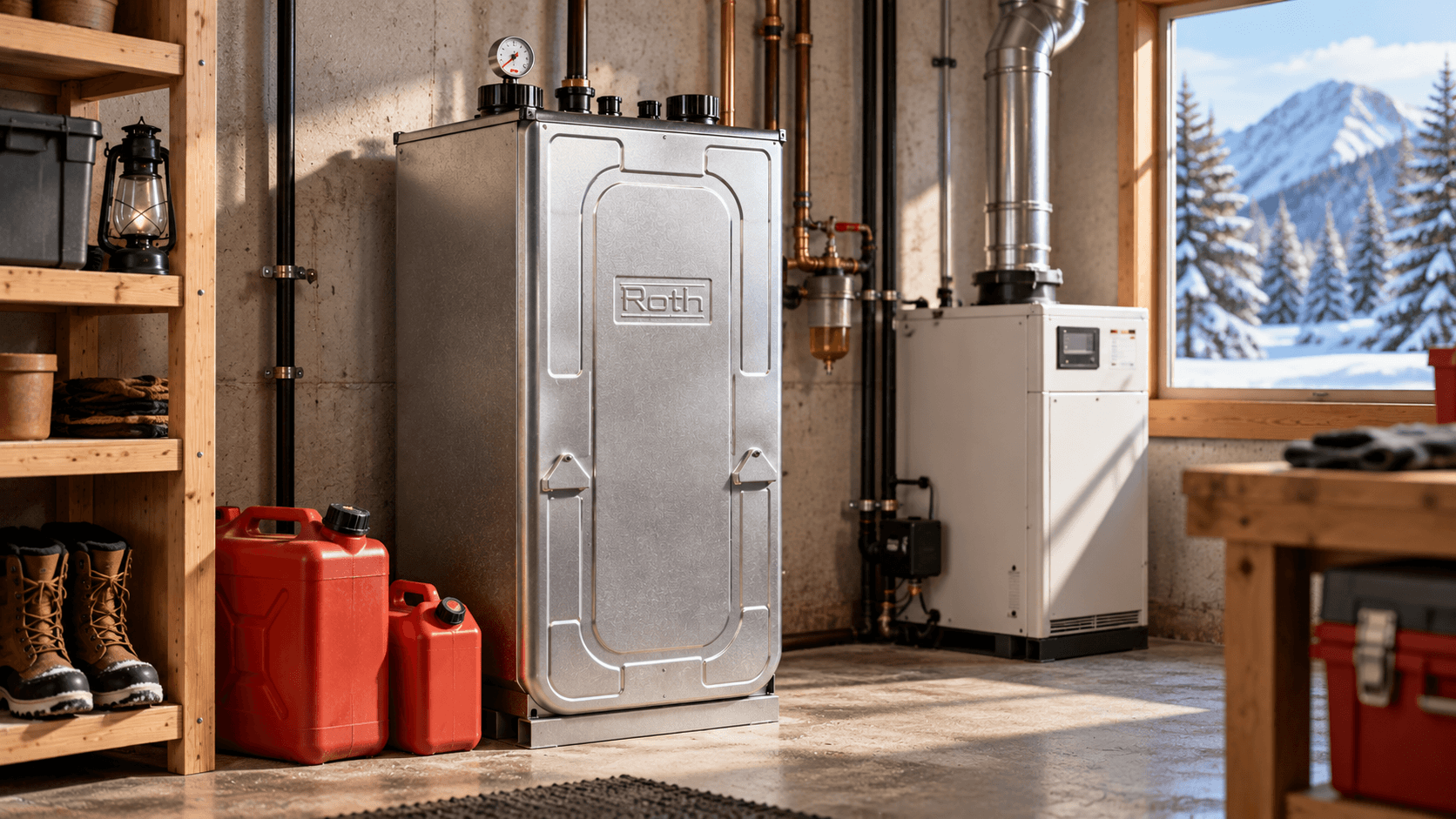
Choosing the right bulk tank size affects how often the tank runs low and how much condensation risk builds up over a season. The heating oil tank sizes guide covers sizing considerations for residential and commercial installations. For the full range of tank options, the heating oil tanks category lists available configurations. Rural Energy carries Roth double-wall heating oil tanks for above-ground storage.
The tank is not a passive container. Its condition directly affects fuel quality. A tank that is corroding, collecting water, or venting improperly will degrade fuel faster than the fuel's inherent chemistry would on its own.
The Alaska DEC heating oil tank guide outlines the following practices for maintaining bulk tank integrity during periods of low or no use:
Keep the tank full during the off-season. A full tank minimizes the air volume available for condensation, limiting water accumulation inside the tank.
Paint outdoor tanks a light color. A light-colored or reflective surface reduces heat absorption and the temperature cycling that drives condensation inside the tank.
Check for water at the tank bottom. Apply water-finding paste to a wooden stick and insert it to the tank bottom. A color change indicates free water. Your fuel dealer can also draw a bottom sample.
Ask your dealer about additives. The Alaska DEC notes that dealers can add an additive to prevent sludge and remove water. This is a dealer-applied measure based on your specific fuel grade and tank condition.
Roth double-wall heating oil tanks use an inner tank and an outer containment shell. The interstitial space between the walls is designed to contain fuel in the event of an inner tank leak. Roth's optical leak alarm signals the presence of fuel in that space; it detects fuel, not water. If liquid appears in the interstitial space, treat it as a fuel leak and respond accordingly. Check the tank bottom for water separately using the water-finding paste method.
If you notice fuel odors around the tank or signs of seepage, the oil tank seeping guide and the oil smell troubleshooting guide cover leak identification and response in more detail.
OFTEC and the Maine DEP put the life of a heating oil tank at about 20 years. An aging tank that is not inspected regularly is a fuel quality risk as well as an environmental liability. For a full look at above-ground tank options, the heating oil tanks category covers the available range.
If you have fuel that shows signs of degradation or that has exceeded your heater manufacturer's recommended guidance, the correct course of action is disposal, not use.
The EPA says never to pour fuel down a drain or onto the ground.
Do not burn degraded fuel in your heater. Degraded fuel causes the burner damage described in the section above. Diluting it with fresh fuel does not restore it to a usable condition.
Contact your local household hazardous waste (HHW) program. The Municipality of Anchorage, for example, accepts kerosene and diesel at its household hazardous waste drop-off for free. Check your local program for locations and accepted materials.
Call your fuel dealer. Your dealer is the right first call for questions about whether a fuel sample is usable and for guidance on disposal options for larger quantities.
Call a qualified heating technician if you are unsure whether your fuel is usable. A technician can assess the fuel, inspect the tank, and advise on next steps before you commit to disposal or continued use.
The disposal cost is real, but it is a fixed, manageable expense. The cost of heater damage from degraded fuel is not.
Rural Energy has served cold-climate and remote communities since 1987. The company sells heaters, tanks, and fuel system parts, ships across the US and Canada, and helps customers by phone and email. Rural Energy does not sell fuel, additives, or fuel cans, and does not install or service on site.
Parts and equipment available:
Roth double-wall heating oil tanks for above-ground residential and commercial bulk storage
Heating oil tanks category for the full range of tank options and configurations
NordicStove fuel tank with quick-connect fittings for NordicStove oil heater systems
Toyotomi fuel filter and Toyotomi fuel filter fittings kit for Toyotomi oil heater maintenance
Toyotomi fuel tank valve kit for fuel tank servicing
Non-electric oil heaters for off-grid and cabin heating applications
Direct-vent oil furnaces for whole-home heating in cold climates
Contact Rural Energy by phone or email for help selecting the right tank, filter, or fuel system components for your specific heater and installation.
A. No. Toyotomi's manuals are explicit: begin each heating season with fresh fuel, and do not use fuel that has turned yellow or has a sour smell, regardless of what it has been mixed with. Adding fresh kerosene to a doubtful batch does not make the batch fit for a heater. The gums, sediment, and water that accumulate in degraded fuel do not dilute away; they remain in the mixture and continue to affect combustion and filter life. ASTM D975 confirms that fuel stabilizers cannot restore fuel that has already degraded. If a stabilizer cannot reverse the chemistry, dilution with fresh fuel cannot either. The correct response to fuel that shows signs of degradation is disposal, not blending. Inspect the tank or container, assess the condition of the fuel, and arrange for disposal if any stop-use indicators are present.
A. No. Red kerosene is not a sign of degradation. Toyotomi's manuals explicitly allow "clear or red colored kerosene" as acceptable fuel. The red color is a dye; it does not make the fuel unfit for use. The warning signs to watch for are different: yellowing or darkening of fuel that was clear or normally colored when purchased, and a sour or sharp smell that differs from fresh fuel. Those are the indicators Toyotomi lists as stop-use conditions. Color change in the wrong direction, not the presence of a dye, is what matters. If you purchased red-dyed kerosene and it smells normal and has not darkened further, the color alone is not a reason for concern. One distinction matters for portable wick heaters, which are a different appliance: the U.S. Consumer Product Safety Commission calls for water-clear 1-K kerosene in those.
A. No. ASTM D975 identifies zinc-coated equipment as a problem for fuel storage because zinc can react with water or acids present in the fuel to form gel-like compounds that rapidly plug filters and fuel system components. Galvanized metal cans, tanks, and fittings are zinc-coated. The reaction can occur even when the fuel appears clean and the container looks undamaged. Use a purpose-made container instead. The U.S. Consumer Product Safety Commission specifies blue containers for kerosene; never use a red container, because red is for gasoline. Toyotomi manuals require that the container be clearly marked with the fuel type. Never use a glass container; Toyotomi manuals state this explicitly. Store the container apart from the gasoline you keep for power equipment, so it cannot be poured into a heater by mistake.
A. Because contaminants do not stay suspended. ASTM D975 notes that in a still tank, sediment, water, and other contaminants settle to the bottom over time. A sample drawn from more than a foot or two above the tank bottom almost always looks clean, regardless of what has accumulated at the bottom. This is why visual inspection of fuel at the fill point or from a sample drawn near the top of the tank is not a reliable assessment of tank condition. The Alaska DEC heating oil tank guide describes the correct method: apply water-finding paste to a wooden stick and insert it all the way to the tank bottom. A color change in the paste indicates free water. Your fuel dealer can also draw a bottom sample and assess it for you.
A. Yes. This is one of the most important points in CRC Report 667: dissolved water does not change how fuel looks. Fuel that contains dissolved water appears completely clear and normal. Only free water, water that has separated out of the fuel and settled, makes fuel visibly cloudy or hazy. This means that a visual inspection alone cannot confirm that fuel is water-free. If you have reason to suspect water contamination, whether from a tank that has been partially empty through temperature swings or from a container that was not properly sealed, use water-finding paste on a stick inserted to the bottom of the tank or container. Do not rely on how the fuel looks from the top. ASTM D975 adds that contaminants settle to the bottom of a still tank, which is where the check belongs.
A. For Toyotomi heaters, the manuals list additives among things never to use, with one exception: a supplier-recommended anti-gel additive for ultra low sulfur diesel or heating oil in cold weather. For bulk storage tanks, the Alaska DEC heating oil tank guide notes that your oil dealer can add an additive to prevent sludge and remove water; this is a dealer-applied measure, not a product to apply independently. On biocides specifically, CRC Report 667 treats biocide treatment as a response to microbial growth that has already been confirmed, and notes that filters may plug for a period as dead microbial growth clears the system. Rural Energy does not sell additives. Replace the Toyotomi fuel filter on the manufacturer's recommended schedule as the baseline maintenance measure.
A. It can. CRC Report 667 notes that fuel purchased in summer can form wax in winter cold, and that wax can plug filters, screens, and sharp bends in fuel lines. This is not a sign that the fuel has gone bad; it is a cold-flow characteristic of certain fuel grades, particularly heating oil #2. ASTM D975 treats blending #1 and #2 oil as a standard practice for cold-weather months to improve cold-flow performance. Ask your supplier what blend you are receiving and whether it is appropriate for your expected winter temperatures. Do not assume that fuel purchased in warmer months is winter-ready. For fuel grade selection and heater compatibility in cold climates, the direct-vent oil furnace guide covers the relevant considerations in detail.
A. Toyotomi's guidance is to plan fuel purchases so that you use up what you have on hand by the end of the heating season and begin the next season with fresh fuel. The manuals list storing fuel for longer than six months among things never to do, so the goal is to arrive at the end of the season with the tank as close to empty as practical. For NordicStove systems, the operating instructions specify a summer shutdown procedure: close the shut-off valve on the fuel line and drain the oil controller completely before leaving the heater for the off-season. The NordicStove fuel tank with quick-connect fittings and the non-electric oil heaters category cover the equipment this procedure applies to.
A. Not directly. Roth double-wall heating oil tanks are fitted with an optical leak alarm that monitors the interstitial space between the inner tank and the outer containment shell. That alarm is designed to detect fuel, not water. If the alarm activates, the correct interpretation is that fuel has leaked from the inner tank into the containment space, and the appropriate response is to treat it as a leak event. Water in the tank bottom is a separate condition that the alarm does not detect. Check for water independently using water-finding paste on a stick inserted to the tank bottom. For a broader look at tank options and configurations, the heating oil tanks category covers the available range, and if you suspect the tank itself is seeping, the oil tank seeping guide covers what to look for.
A. Yes, for Toyotomi heaters. Toyotomi's manuals state that when running on ultra low sulfur diesel or heating oil the heater "should be serviced at least every two years." With 1-K kerosene or No. 1 fuel oil it can be serviced less often. Toyotomi gives the reason: ultra low sulfur diesel distills heavier than 1-K kerosene and No. 1 fuel oil. If you are unsure which fuel grade your heater is running on, or whether your service interval suits that grade, consult your heater manual or a qualified technician. Rural Energy sells heaters, tanks, and fuel system parts and ships across the US and Canada, but does not install or service on site. Contact Rural Energy by phone or email for parts availability and compatibility questions.