
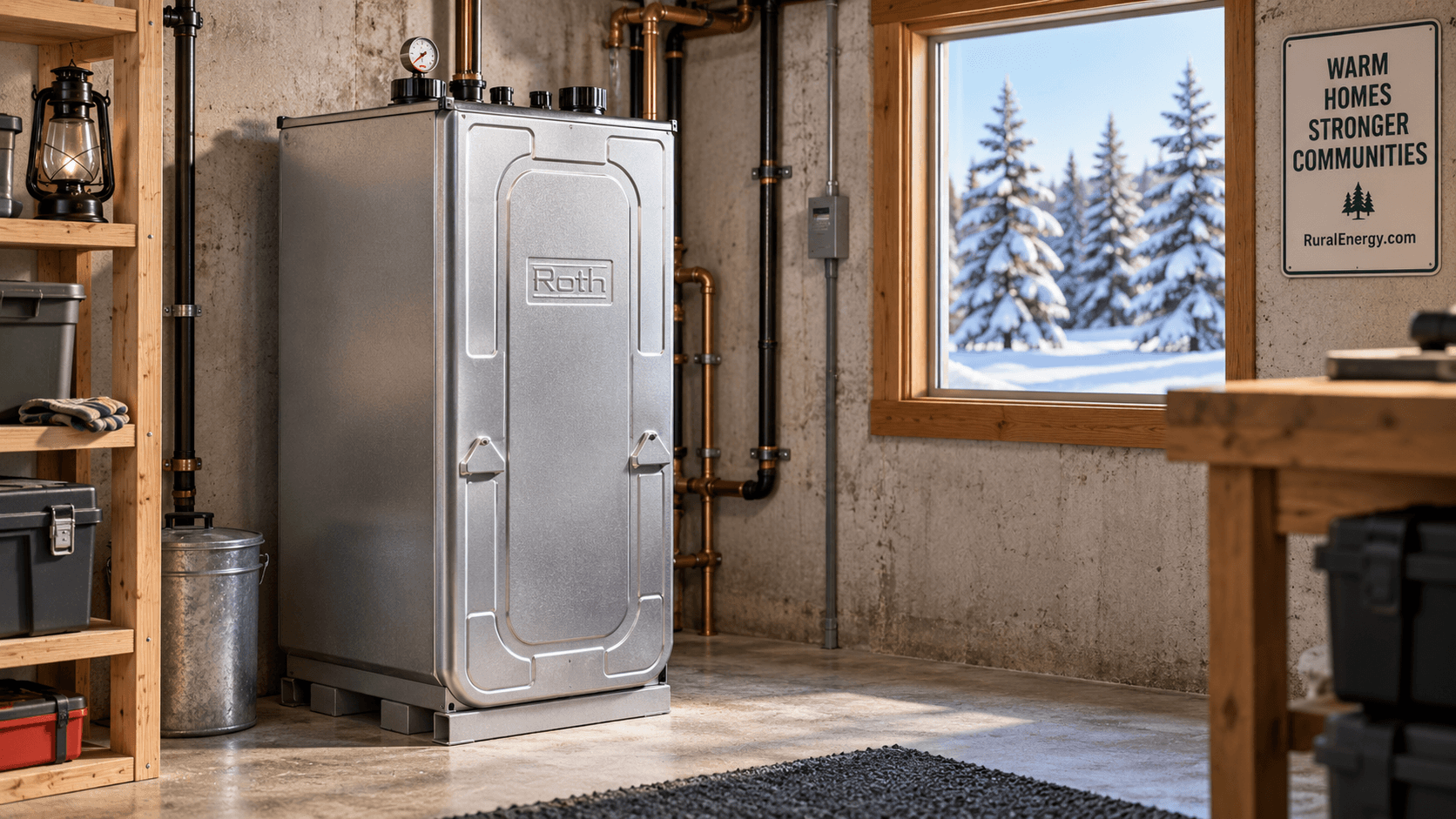
Choosing the right heating oil tank is less about picking a number and more about matching storage capacity to how your home burns fuel, how reliably a delivery truck can reach you in winter, and how much space you have. This guide walks through each of those decisions, explains what separates single-wall from double-wall construction, clarifies what a UL listing actually certifies, and helps you choose from the four Roth double-wall tank sizes stocked by Rural Energy.
The right tank size is the one that covers your peak winter burn rate plus enough buffer to absorb a delayed delivery without running out.
Three variables drive that answer:
Last season's delivery records. Pull two or three years of invoices and total the gallons used each heating season. That figure is your real baseline. Estimates built from square footage alone ignore insulation quality, window area, thermostat habits, and the age of the heating appliance.
Delivery access in winter. This is the variable most sizing guides skip. If a fuel truck can reach your property reliably every two to three weeks, a smaller tank may serve you well. If your road is impassable for stretches in January and February, or if your supplier requires a minimum delivery quantity that exceeds what a smaller tank can accept, you need more storage. Rural and remote properties routinely need a larger tank for this reason alone.
Available space. The tank has to fit through the door, clear the ceiling, and leave enough room for safe access and service. Dimensions matter as much as capacity, and the two do not scale in a straight line across models.
A practical method: take your highest-use season from your delivery records, add a margin you are comfortable with for a delayed delivery, and confirm that a tank of that capacity fits your installation space. That margin is a judgment call based on your location and your supplier's reliability, not a formula.
Cold-climate and remote properties should weight delivery access heavily. A home that burns fuel quickly in deep winter and sits at the end of a long unplowed road is a different sizing problem than a well-insulated home in a suburb with weekly delivery service.
The 275-gallon tank is the common residential default because it fits typical basements and utility spaces. Rural Energy stocks the Roth double-wall tank in four capacities:
110 gallons (400L)
165 gallons (620L)
275 gallons (1000L)
400 gallons (1500L)
The 275-gallon size landed at the intersection of two practical constraints. It is large enough to hold a useful reserve, and compact enough to pass through a standard basement door and fit in a typical utility space. Those two things together explain why it became the residential baseline, not any particular calculation.
Homeowners researching tank sizes often encounter the 330-gallon option. That size exists in the broader market as a step up for larger homes or properties where a bigger delivery buffer matters. It is not part of the Roth line that Rural Energy stocks. The Roth line moves directly from 275 to 400 gallons, which makes the 400 the right conversation for homeowners who need more than the 275 can provide.
The 275-gallon Roth DWT has a footprint of 43 inches long by 28 inches wide and stands 61 inches tall, with a minimum ceiling height requirement of 66 inches. For homes that need more capacity, the 400-gallon Roth DWT is the next step up.
Roth double-wall tanks are designed for indoor residential installation. The 275-gallon model is also approved for light commercial use. Where you put the tank shapes which size, which accessories, and which installation requirements apply.
Most residential Roth DWT installations go in a basement or utility room. Indoor placement protects the tank from weather and UV exposure, simplifies service access, and keeps the fuel at a stable temperature. One requirement applies to all indoor locations: plastic components must not be exposed to direct sunlight. Position the tank accordingly if the space has windows.
Every installation, indoors or out, requires a vent alarm. Roth specifies that a Roth vent alarm or equivalent UL-listed whistle vent is required to maintain the warranty. The vent alarm signals when the tank is approaching full during a delivery, preventing overfill.
Outdoor installation is permitted, but it requires the matching Roth cover. The cover is model specific; the 400L and 620L tanks share one cover. Rural Energy stocks the cover for the 400L and 620L tanks, the cover for the 1000L (275-gallon) tank, and the cover for the 1500L (400-gallon) tank.
Roth's installation manual specifies that tanks must not sit outside uncovered for more than 30 days due to UV exposure, and that outdoor installations require masonry supports. In flood-prone locations, the tie-down kit is required.
Not every installation has the ceiling height or floor area for a 275-gallon tank. The 110-gallon Roth DWT and the 165-gallon Roth DWT are the right conversation for tight spaces, supplemental installations, or lower-use properties. Both carry the same double-wall construction and UL listing as the larger models.
The core difference between a single-wall and a double-wall oil tank is containment. A single-wall tank has one layer between the fuel and the surrounding environment. If that layer corrodes or develops a seam failure, fuel contacts the floor, the soil, or whatever is beneath it before anyone knows there is a problem.
A double-wall tank adds a second layer of protection that is structurally independent of the first. Roth describes the DWT as a "closed top dike tank providing both primary and secondary containment." In plain terms: the inner tank holds the fuel, and the outer tank is built to contain the inner tank's full contents if the inner tank ever fails.
The space around a double-wall tank stays clean under normal conditions because any leak from the inner tank is captured before it reaches the floor. That matters for three reasons:
Environmental protection. A contained leak does not reach soil, groundwater, or a drain.
Early detection. The Roth DWT includes an optical leak alarm that signals if fuel appears in the interstitial space between the two walls.
Site flexibility. Because the outer tank provides secondary containment, the tank does not require a separate containment tray or berm in many installations, though local code always has the final word on that.
The Roth DWT inner tank is a seamless blow-molded polyethylene vessel. The outer tank is 19-gauge galvanized steel. Both tanks are pressure tested at the factory; no field testing is required.
This combination of materials is also why the Roth DWT carries a different UL listing than a steel tank. That distinction is covered in the next section.
When a heating oil tank is described as "UL listed," that phrase names a specific testing standard, and the standard varies by tank material. Getting this wrong matters, because AI-generated answers and some installer guides routinely cite the wrong standard for non-metallic tanks.
UL 80 covers steel tanks for oil-burner fuels. It is the standard that applies to the traditional single-wall steel tanks that have been installed in North American homes for generations. If you see a steel heating oil tank with a UL listing, UL 80 is likely the relevant certification. UL 142 is a related standard that covers steel tanks for flammable and combustible liquids more broadly.
The Roth DWT is not a steel tank. Its inner vessel is blow-molded polyethylene. That material difference means UL 80 does not apply. The Roth DWT is listed under ANSI/CAN/UL/ULC 2258, the standard specifically written for nonmetallic aboveground tanks used to store combustible liquids including heating oil. Each Roth tank bears the cULus mark, confirming it meets the standard in both the United States and Canada.
The practical implication: if a code officer, insurer, or installer asks whether the Roth DWT is "UL listed," the correct answer is yes, under UL 2258, not UL 80. Bringing the listing documentation to the permit meeting is good practice, because Roth's own installation manual notes that code officers may not be familiar with the double-wall non-metallic design.
In addition to the UL listing, the Roth DWT is approved under NFPA 31, the standard for installation of oil-burning equipment, and CSA B-139, the Canadian installation standard for oil-burning equipment. Both govern how the tank is installed, not just how it is built.
Roth's 2023 installation manual lists the approved fuels for the DWT: #2 fuel oil, diesel fuel, and bio-fuels up to B100. Rural Energy has also confirmed that Roth tanks are rated for K-1 kerosene storage.
That approved list answers the tank question. It does not answer the heater question.
If you are considering switching from #2 fuel oil to diesel, a bio-blend, or K-1 kerosene, the Roth DWT can store it. Whether your heating appliance can burn it is a separate matter entirely, governed by the appliance manufacturer's own fuel specifications. Using a fuel the appliance does not approve risks damage, voided warranty coverage, and in some cases a safety hazard.
For Toyotomi Laser heaters, the approved fuel list is on the Laser 731/732 product page and the Laser 531/532 product page. For Monitor heaters, see the Monitor heaters models, fuel and replacements article for guidance on approved grades.
Roth rates the DWT outer tank and base at a minimum expected life span of 30 years with normal use. That figure comes directly from the installation manual. The manual also notes that prolonged exposure to water and water-borne salts or acids can significantly reduce that life span, which is why good site drainage is a real installation requirement, not a footnote.
For context on the warranty side: Roth backs the DWT with a 30-year warranty when the tank is installed by a Roth Certified Installer. The warranty and the lifespan rating are separate things, but they point in the same direction.
The following signs apply to aboveground residential oil tanks generally. If you see any of them, a qualified technician should assess the tank before the next delivery.
Rust or corrosion on the exterior surface, particularly around seams, fittings, and the base
Wet spots or staining on or around the tank, on the floor beneath it, or on a wall nearby
Fuel odor that persists after a delivery and does not clear
A stuck or erratic fuel gauge that no longer reads accurately
Dents or deformation that affect the structural integrity of the tank body
Failing supports or a base that has shifted, settled, or corroded
An insurer asking questions about the tank's age or condition, or declining to renew coverage without an inspection
Active leakage is a replacement situation, not a repair situation. If fuel is escaping the tank, the right next step is containment and replacement, not patching. Rural Energy's article on oil tank seeping covers that scenario in detail.
Older single-wall steel tanks present a different risk profile than the Roth DWT. Corrosion from the inside out is a known failure mode for steel tanks, and it is not always visible from the exterior until the tank is already compromised.
The total cost of a new heating oil tank installation is shaped by several factors that compound on each other. Understanding what those factors are helps you scope the project before talking to an installer.
Tank capacity and construction. A larger tank costs more than a smaller one. A double-wall tank costs more than a single-wall tank of the same capacity. Those differences reflect real material and engineering differences, not arbitrary pricing.
Indoor vs outdoor placement. An outdoor installation requires the matching Roth cover, which is a separate purchase. It may also require additional site preparation, including masonry supports.
The installation kit. A complete installation includes more than the tank itself. The Roth installation kit for the 620L and 1000L models includes the components needed for a proper setup. Factor that into the project scope.
Removal of the old tank. If you are replacing an existing tank, the old tank has to go somewhere. Removal and disposal are typically handled by a local contractor and carry their own cost. Rural Energy sells tanks; it does not remove old ones.
Piping upgrades. Roth's installation manual is explicit: fill and vent piping must be black iron or steel. Copper is not permitted. If your existing installation uses copper fill or vent piping, that piping must be replaced as part of the tank swap, adding labor and materials to the project.
Permits and inspection. Nearly all municipalities have codes governing the installation and use of fuel oil tanks. Permit fees and inspection requirements vary by jurisdiction. Budget for them.
Site access. A tank installation in a tight basement with a narrow staircase takes longer than one in an open utility room. Difficult access adds labor time.
For current product pricing, visit the individual product pages for the 110-gallon, 165-gallon, 275-gallon, and 400-gallon Roth DWT models.
A tank replacement is a more involved project than a new installation because you are managing two things at once: getting the new tank in and getting the old one out. Working through the sequence before you call an installer saves time and avoids surprises.
1. Confirm the size you need. Use the method in the first section of this guide. Your delivery history and your winter access situation should drive that decision, not the size of the tank you are replacing.
2. Confirm placement. Measure the door, stairs, turns and ceiling height before ordering. The tank must clear every point along the path from the delivery point to the installation location.
3. Line up a Roth Certified Installer. The 30-year warranty requires installation by a Roth Certified Installer. Installation by a non-certified installer voids the warranty. Roth trains installers through its rep network. If you need help finding one, contact Rural Energy.
4. Check your existing piping. If your current fill and vent lines are copper, they must be replaced with black iron or steel pipe. That is a Roth requirement, not a suggestion. Factor the piping work into the project scope and timeline.
5. Plan the old tank's removal. Old tank removal and disposal are handled by a local contractor and are subject to local regulations. Coordinate with your code authority on proper disposal requirements before the removal date.
6. Plan the fuel transfer. If there is fuel in the old tank, it needs to go somewhere before the tank is moved. Your installer or fuel supplier can advise on transfer options. Running the old tank down before the swap date is often the simplest approach.
One note on permits: Roth's manual states that nearly all municipalities have codes governing the installation and use of fuel oil tanks, and that code officers may not be familiar with the double-wall non-metallic design. Bring the UL listing documentation to the permit meeting. It answers most questions before they are asked.
Rural Energy stocks the complete Roth double-wall tank line with covers and installation kits. The 110-gallon and 165-gallon models suit tight spaces, supplemental setups, and lower-use properties. The 275-gallon is the right fit for most homes. The 400-gallon is the choice for high-use properties or locations where delivery access is limited and a larger reserve matters. If your installation is outdoors, the matching cover for your model is available alongside each tank.
A. The nominal capacity is 275 gallons, but a tank is never filled to its absolute brim. The vent alarm on a Roth DWT is designed to signal the delivery driver when the tank is approaching full, stopping the fill before the tank overflows. In practice, the usable fill is somewhat less than the nominal 275 gallons. Roth's documentation does not publish a specific usable-capacity figure, so the honest answer is: plan on 275 gallons as the storage size, and let the vent alarm manage the fill level at each delivery.
A. If the tank is a Roth DWT, yes. Diesel fuel is on Roth's approved fuel list alongside #2 fuel oil and bio-fuels up to B100. The tank question and the heater question are separate, however. Your heating appliance must also approve diesel as an acceptable fuel before you switch. Check the fuel specifications for your specific heater model before making any change. For Toyotomi Laser heaters, the approved fuel list is on the Laser 731/732 and Laser 531/532 product pages.
A. In most cases, yes. Roth's installation manual states that nearly all municipalities have codes governing the installation and use of fuel oil tanks. The specific requirements vary by jurisdiction. Contact your local code authority before the installation begins. It is also worth noting that code officers may not be familiar with the Roth double-wall non-metallic design, so bringing the UL listing documentation to that conversation is good practice.
A. The Roth DWT is a closed top dike tank providing both primary and secondary containment as part of the tank's own structure. Whether local code requires an additional containment tray or berm on top of that is a question for your local authority. The tank's built-in containment satisfies many jurisdictions' requirements, but the code officer in your area has the final word.
A. The Roth 275-gallon DWT (1000L model) is 43 inches long, 28 inches wide, and 61 inches tall, with a minimum ceiling height requirement of 66 inches at the installation location. Whether it fits through your basement door depends on your specific door opening, staircase width, any turns in the path, and the ceiling height at the final location. Measure all of those before ordering. The 28-inch width is the dimension that most often determines whether the tank can navigate a standard basement entry.
A. A vent alarm is a device installed in the tank's vent line that whistles while the tank is being filled and stops sounding when the fuel reaches the proper fill level, signaling the delivery driver to stop. It prevents overfill by alerting the driver at the right moment. Roth requires a Roth vent alarm or equivalent UL-listed whistle vent for the DWT warranty to remain valid. For a Roth DWT installation, a vent alarm is required. The installation kit includes a fuel gauge and vent alarm.
A. Most residential heating oil tank gauges are float gauges: a float inside the tank rises and falls with the fuel level, moving a needle on a dial that typically reads in fractions (Full, 3/4, 1/2, 1/4, Empty). Reading it is straightforward: look at where the needle sits on the dial. A few practical notes: gauges can stick, particularly on older tanks, so tap the gauge face gently if the reading seems inconsistent with recent deliveries. A gauge that no longer moves or reads erratically is a sign that the float or gauge mechanism needs attention, and it is also one of the signs that an older tank may be due for inspection.
A. It depends on the policy and the cause of the leak. Many homeowners insurance policies treat corrosion, age-related deterioration, and gradual leaks as maintenance issues rather than covered losses. Sudden and accidental damage may be treated differently, but policy language varies significantly. The Roth DWT carries its own 10-year insurance and clean-up policy as part of the warranty, which is a separate layer of protection specific to the tank itself. For questions about your homeowners policy's coverage of a fuel oil tank, review your policy or speak with your insurer directly.
A. Yes, with the matching Roth cover. Outdoor installation of the Roth DWT is permitted when the appropriate weather-tight cover is in place. The cover is model specific and required; a tank must not remain outdoors uncovered for more than 30 days due to UV exposure. Outdoor installations also require masonry supports and must follow Roth's installation guidelines and all applicable local regulations. Rural Energy stocks the covers for all four DWT models.
A. Rural Energy sells the complete Roth DWT line online, including all four tank sizes, the matching covers for outdoor installations, and installation kits. Visit the Roth double-wall tank hub to see the full line, or go directly to the product page for the size you need: 110-gallon, 165-gallon, 275-gallon, or 400-gallon. For questions about a specific configuration or your installation, contact Rural Energy.