
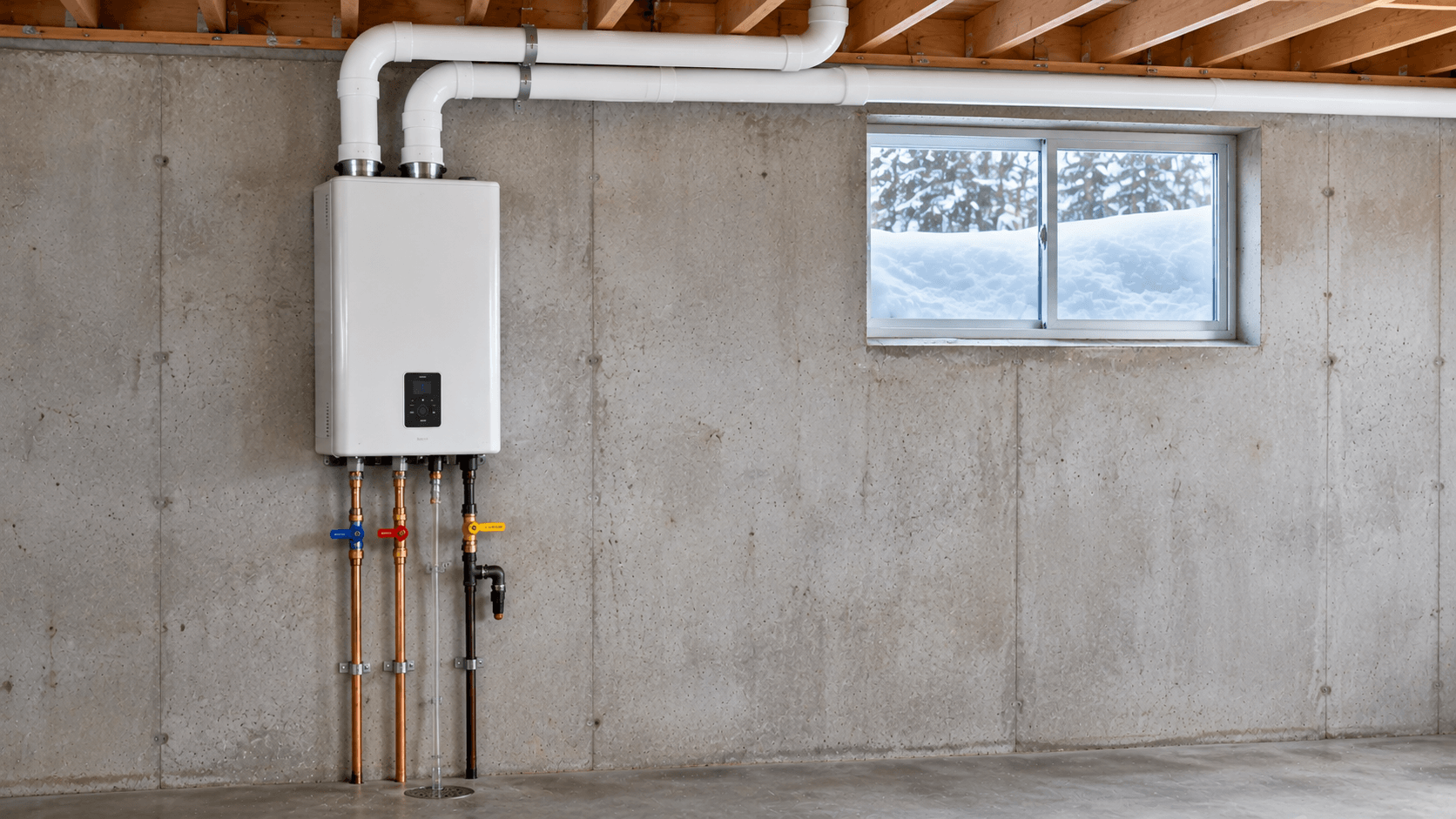
Size a tankless water heater by the flow you need at the temperature rise your coldest incoming water demands, and a tank heater by its first hour rating against your busiest hour. In a cold climate the rise is larger, so the same unit delivers less hot water than its headline rating suggests. Read the manufacturer's flow-at-rise table, not the headline GPM, and read from the row at or above your actual rise.
Every water heater has a maximum heat output. What changes is how much work it has to do. That work is the temperature rise: the gap between your cold supply and the hot water you want at the tap. The larger the rise, the less flow the unit can sustain.
According to the U.S. Department of Energy's Building America guide to tankless water heaters, size is set by the maximum temperature rise from cold inlet to hot outlet and the maximum flow rate demanded at the same time. The DOE also notes directly that a house in a cold climate has a higher demand because the cooler incoming water must be raised further, and that if the unit is too small, hot water supply will be limited.
That constraint shows up in the ratings as well. ENERGY STAR measures tankless water heater GPM over a 67°F temperature rise. Manufacturers often publish a second, more favorable headline number at a smaller rise. The Bosch Therm 940 ES, for example, is rated at 9.4 GPM at a 35°F rise and 6.0 GPM at a 55°F rise. A home whose incoming water is cold enough to require a 55°F rise gets 6.0 GPM from that unit, not 9.4. The headline number is not wrong; it just does not apply to your conditions.
The table below shows the rise required to reach 120°F (the DOE target for most uses) from five incoming-water temperatures. These are arithmetic results, not regional claims. Your actual rise depends on your actual incoming-water temperature.
|
Incoming water (°F) |
Target outlet (°F) |
Temperature rise needed |
|---|---|---|
|
40 |
120 |
80°F |
|
45 |
120 |
75°F |
|
50 |
120 |
70°F |
|
55 |
120 |
65°F |
|
65 |
120 |
55°F |
The physical outer bound is 88°F: liquid water cannot be colder than 32°F, so the largest possible rise to a 120°F outlet is 88°F. No real home reaches that extreme, but it establishes the ceiling for any sizing calculation.
The DOE recommends getting your incoming-water temperature from your local water utility, and using its minimum value, not an average. If you are on a well, or if you are sizing for a seasonal cabin, there is no utility to ask: measure the cold tap with a thermometer in mid-winter, after running the water long enough to draw from the supply line rather than the water standing in the pipes.
Use the minimum, not the average. A unit sized to an average will fall short on the coldest days, when the rise is largest.
Once you have your coldest incoming temperature, the calculation is straightforward:
For example, if your coldest incoming water is 45°F, your rise is 75°F. That is the number you will carry into every sizing step that follows. A unit that cannot sustain your required flow at a 75°F rise is undersized for your conditions, regardless of its headline rating.
Peak flow is the total gallons per minute your household draws when the most fixtures run at the same time. The DOE cites American Society of Plumbing Engineers (ASPE) figures for typical fixture flow rates:
|
Fixture |
Typical flow rate (GPM) |
|---|---|
|
Shower |
2.5 |
|
Kitchen sink |
2.5 |
|
Laundry sink |
4.0 |
|
Bathtub |
2.4 to 4.0 |
|
Dishwasher |
1.9 |
Add the flows of the fixtures most likely to run at the same time, not every fixture in the house. Typical combinations to consider:
Be honest about your household's actual habits. A single person in a cabin rarely runs two showers simultaneously. A household with teenagers and a busy morning routine might. Use the combination that reflects your realistic peak, and carry that number into Step 3.
Note that the DOE also reports a minimum activation flow of 0.4 to 0.9 GPM for tankless units. A very slow trickle may not generate enough flow to start the burner or element. This matters most for low-flow faucets and point-of-use applications, which are covered separately below.
Once you have your temperature rise and your peak flow, find the manufacturer's flow-at-rise table for the unit you are considering. Locate the row at or above your actual rise, rounding up to the next listed row if your rise falls between two. Never round down. Rounding down overstates what the unit will deliver.
The Toyotomi OM-122DW oil-fired semi-on-demand water heater publishes the following flow-at-rise table:
|
Temperature rise |
Flow rate (GPM) |
|---|---|
|
40°F |
6.1 |
|
50°F |
4.8 |
|
60°F |
4.0 |
|
70°F |
3.5 |
|
80°F |
3.0 |
Using the shower-plus-dishwasher household from Step 2 (4.4 GPM peak):
A shower alone (2.5 GPM) is a different picture. Even at an 80°F rise the OM-122DW delivers 3.0 GPM, which covers a single shower at any rise in the table.
The rule is the same for every unit: find the row at or above your rise, check that the listed flow meets or exceeds your peak demand. If the table stops before it reaches your rise, assume the unit delivers less than its lowest listed row.
The Bosch Therm 940 ES (199,000 BTU/h) lists 9.4 GPM at a 35°F rise and 6.0 GPM at a 55°F rise. A household needing 5.0 GPM at a 55°F rise is covered. At a 65°F rise the published figures stop short, so the unit delivers less than 6.0 GPM; confirm the figure in Bosch's manual before counting on it for two showers.
The Bosch Therm 830 ES (175,000 BTU/h) lists 8.3 GPM at a 35°F rise and 5.3 GPM at a 55°F rise. Lower input BTU means lower flow at any given rise. For the same household needing 5.0 GPM at a 55°F rise, the 830 ES delivers 5.3 GPM and meets the demand. At a larger rise, check the spec table.
For a detailed comparison of Bosch Therm models for cold climates, see Bosch tankless water heaters for cold climates. For condensing versus non-condensing differences, see condensing vs. non-condensing tankless water heaters.
The Bosch Tronic 6100 C (18 kW) is rated at 3.51 GPM at a 77°F rise. That is the unit's own rating condition, not the ENERGY STAR test rise. At a 77°F rise, this unit covers a single shower (2.5 GPM) with margin. It is sized for one bathroom. A household needing to run a shower and a dishwasher simultaneously at a large rise will need a higher-output electric unit or a gas or oil-fired alternative.
Storage tank heaters are sized differently from tankless units. The key number is the First Hour Rating (FHR), not tank capacity alone.
According to ENERGY STAR, the First Hour Rating is an estimate of the maximum volume of hot water in gallons that a storage water heater can supply within an hour that begins with the water heater fully heated, measured at a 125°F outlet. It reflects both the stored volume and how quickly the heater recovers, which is why two tanks of the same size can carry different ratings.
To size a storage heater for your household, estimate your peak hour: the single hour of the day when hot water use is highest. Add up how much hot water is used in that hour across all fixtures and appliances. Then select a unit whose FHR meets or exceeds that estimate. The FHR is printed on the EnergyGuide label.
In a cold climate, recovery takes longer because the incoming water is colder and needs more heat to reach the setpoint. This matters most for mini-tanks used at a point of use.
The Bosch Tronic 3000T (7 gallon, 1,440 W) recovers 6.8 gallons per hour at a 90°F rise. That rating is a manufacturer test condition, not a supply temperature anyone should expect. The element's output is fixed, so at a smaller rise it reheats more water in an hour, and at a larger rise less.
Rural Energy sells the Bosch Tronic 3000T in 2.7, 4 and 7 gallon sizes. These are point-of-use units suited to a single sink or as a buffer at a distant fixture, not as whole-home storage heaters. Rural Energy does not sell full-size storage tank heaters.
The fuel type determines how a unit's output scales with temperature rise, and what infrastructure is required before installation.
Input BTU/h is the primary sizing lever for gas units. Higher input means more heat available at any given flow rate, which translates to more GPM at a large rise. The Bosch Therm 940 ES and the Rinnai RE199iN are both rated at 199,000 BTU/h, the highest input of the gas units in this guide. The Rinnai RE180iN at 180,000 BTU/h and the Bosch Therm 830 ES at 175,000 BTU/h are the next tier. For cold-climate sizing, the difference in BTU/h between tiers is meaningful: it directly affects how much flow is available at rises above 55°F.
The gas supply line must be sized by a qualified installer from the unit's manual. The manual specifies the input rate; the installer determines the pipe size from that rate and the run length. That is not a step to estimate from published guides.
For a comparison of two other Rinnai tankless models, see the Rinnai RL75i vs RL94i guide.
For electric units, kilowatts replace BTU/h as the output measure. The Bosch Tronic 6000 WH27 at 26.9 kW delivers 5.3 GPM at a 45°F rise. The Bosch Tronic 6100 C at 18 kW delivers 3.51 GPM at a 77°F rise.
The electrical service requirement is the critical installation constraint. The Tronic 6100 C requires three dedicated 240 V, 30 A circuits. The Tronic 6000 WH27 draws 112.5 A at 240 V, more than the entire capacity of a 100 A service. Before specifying any electric tankless unit, a licensed electrician must confirm the panel can support the load.
The Toyotomi OM-122DW operates on No. 1 or No. 2 fuel oil, ultra-low-sulfur diesel or K-1 kerosene. It requires a standard 120 V electrical connection and has a venting limit of 10 feet with 3 bends or fewer. The venting constraint is a hard installation limit: a longer run or more bends requires a different unit or a different installation layout. At 148,000 BTU/h input and 88% efficiency, the OM-122DW's flow-at-rise performance was shown in Step 3.
For more on oil-fired water heaters, see the oil water heater category.
Heat pump and solar water heaters are available in the broader market but are not products Rural Energy carries. Sizing guidance for those types is outside the scope of this article.
Not every installation is a whole-home system. A single sink in a shop, a shower in a remote cabin, or a kitchen faucet at the end of a long supply run may need its own dedicated unit.
The Bosch Tronic TR4000C-3 (3.5 kW) and the Bosch Tronic TR4000C-6 (6.5 kW) are designed for a single sink. The TR4000C-6's higher output is better suited to colder incoming water: more kilowatts means more heat available to bridge a larger rise at the same flow rate. If your incoming water is cold and you are heating a single sink, the TR4000C-6 is the more reliable choice.
The Bosch Tronic 3000T mini-tanks (2.7, 4 and 7 gallon) store a small volume of pre-heated water at the point of use. They eliminate the wait for hot water to travel from a distant central heater and reduce the flow demand on the main unit. They are not sized to supply continuous flow for a shower; they are a buffer for a single sink or a supplemental unit at a distant fixture.
One constraint that affects small cabins and point-of-use installations is minimum activation flow. The DOE reports that tankless units typically require 0.4 to 0.9 GPM of flow before the burner or element activates. The Rinnai RE199iN activates at 0.4 GPM; the Bosch Therm 940 ES activates at 0.5 GPM. A low-flow faucet aerator or a partially closed valve may produce flow below the activation threshold, and the unit will not fire. In a small cabin where a single low-flow faucet is the only fixture, this is worth checking against the specific unit's specification before purchase.
Choosing the right unit on paper is only part of the process. Several physical constraints at the installation site can limit which unit will actually work, regardless of its output rating.
The DOE notes that tankless units typically need a 3/4 inch or 1 inch cold supply line. Older homes may have only a 1/2 inch line, which can limit the flow reaching a whole-home unit. A plumber can assess the existing supply line before you select a unit.
Gas line sizing and venting are the installer's responsibility, determined from the unit's manual and the specific conditions of the installation. The OM-122DW's 10-foot, 3-bend venting limit is a hard constraint: it affects where in a building the unit can be placed. Gas units have their own venting requirements; consult the manual for the specific model and have a qualified gas technician size the supply line.
As noted above, the Tronic 6100 C requires three dedicated 240 V, 30 A circuits and the Tronic 6000 WH27 draws 112.5 A. These are not figures to estimate around. A licensed electrician must verify the panel before any electric tankless unit is installed.
The DOE reports that above 8 to 14 grains per gallon of hardness, manufacturers may require a water softener. Scale buildup restricts flow through the heat exchanger and shortens its service life. If your water supply is hard, check the manufacturer's hardness requirements before selecting a unit. ScaleRX water treatment products are available through Rural Energy for applications where scale is a concern.
The Rinnai RE199iN is approved for installation up to 10,200 feet. Altitude approval varies by model. If your installation is at elevation, check the specific model's manual before purchasing. Combustion performance at high altitude is not something to verify after the unit arrives.
Tankless units installed in unheated spaces or in locations subject to freezing temperatures require specific precautions. Keep the unit in a heated space where possible, or follow the manufacturer's freeze protection guidance in the installation manual. The manual is the authoritative source; no general rule applies across all models.
A single tankless unit sized to the coldest month and the peak simultaneous demand will handle many households. Two situations call for a different approach.
When a fixture is far from the main water heater, the supply line holds a volume of cold water that must be purged before hot water arrives. A point-of-use mini-tank or a small point-of-use electric tankless unit at the distant fixture eliminates that wait and reduces the instantaneous demand on the main unit. The main unit sizes to the remaining peak load; the point-of-use unit handles the local fixture independently.
Some installations require more output than any single residential unit can provide. The Bosch Therm spec tables list Intelligent Cascading as a supported configuration. Cascading connects two or more units so they respond to demand together, adding their output. If your peak demand at your required rise exceeds what the largest single unit can deliver, cascading is the path forward. A qualified installer configures cascading from the manufacturer's instructions.
In both cases, the sizing method is the same: calculate the temperature rise from your coldest incoming water, establish your peak simultaneous flow, and confirm that the unit or combination of units meets that flow at that rise. Size to the coldest month, not the annual average. The coldest month is when the incoming water is coldest and the rise is largest.
If you have your coldest incoming-water temperature, the fixtures you run at the same time, and your fuel type or electrical service details, Rural Energy can help you match those numbers to the right unit. Rural Energy does not install or repair; customers rely on a local qualified installer (plumber, electrician, gas or oil technician) for the physical work. But choosing the unit is a step Rural Energy handles by phone and email.
Rural Energy ships water heaters across the United States and to Canada. Browse the full range at water heaters, or go directly to gas tankless, electric tankless or oil-fired units.
A. At a 60°F temperature rise, the Toyotomi OM-122DW delivers 4.0 gallons per minute, which equals 240 gallons in an hour of continuous operation. At a larger rise the output drops: at a 70°F rise it delivers 3.5 GPM (210 gallons per hour), and at an 80°F rise it delivers 3.0 GPM (180 gallons per hour). The unit is semi-on-demand, meaning it maintains a small reserve of hot water and fires to replenish it, so real-world delivery depends on your draw pattern as well as the temperature rise. Always read the flow-at-rise row at or above your actual rise, rounding up if your rise falls between listed rows, to avoid overstating what the unit will deliver at your conditions.
A. Yes. The Toyotomi OM-122DW is approved to burn No. 1 fuel oil, No. 2 fuel oil, ultra-low-sulfur diesel or K-1 kerosene. Not all oil-fired water heaters accept the same fuel range; always confirm the approved fuel list in the specific model's installation manual before filling the tank. Use only a fuel the manual lists. For a detailed comparison of these fuels and their practical differences in off-grid and rural applications, see the kerosene vs. diesel vs. heating oil guide.
A. A 7 gallon Bosch Tronic 3000T stores 7 gallons of pre-heated water and recovers at 6.8 gallons per hour at a 90°F rise. Running hot at the ASPE kitchen-sink rate of 2.5 GPM, 7 gallons lasts under three minutes (7 / 2.5 = 2.8). Once that stored volume is gone, the unit depends on recovery: 6.8 gallons per hour at a 90°F rise, or roughly 0.11 gallons per minute, well below a typical faucet flow rate. The mini-tank is best understood as a buffer for intermittent use at a single fixture, not as a continuous-flow unit. The Tronic 3000T 7 gallon is available from Rural Energy.
A. The Bosch Tronic 6100 C (18 kW) requires three dedicated 240 V, 30 A circuits. The Bosch Tronic 6000 WH27 (26.9 kW) draws 112.5 A at 240 V. A home with a 100 A main service cannot support the WH27 without a panel upgrade. Point-of-use units like the Tronic TR4000C-3 (3.5 kW) and TR4000C-6 (6.5 kW) have much lower electrical demands. Before purchasing any electric tankless unit, have a licensed electrician evaluate the panel and confirm the available capacity. The electrician, not the product specification, is the authoritative answer for your specific installation.
A. Possibly: the Bosch Therm 940 ES and Rinnai RE199iN are both rated at 199,000 BTU/h input, and whether your line can supply that is a gas technician's call. Whether your existing line can supply that rate depends on the pipe diameter, the length of the run, the number of fittings, and the total gas load from all appliances on the line. The unit's installation manual specifies the required input rate; a qualified gas technician sizes the supply line from that figure and the conditions of your installation. This is not a step to estimate from a general guide. Rural Energy does not install; a licensed gas technician must assess and modify the gas supply before the unit is commissioned.
A. Well water is not treated by a utility, so its hardness is unknown until it is tested. The DOE reports that above 8 to 14 grains per gallon of hardness, manufacturers may require a water softener before the unit. Scale deposits inside a heat exchanger restrict flow, reduce output, and can shorten the unit's service life. If you are on a well, have the water tested for hardness before selecting a unit, and check the manufacturer's hardness limit in the installation manual. Where scale is a concern, ScaleRX water treatment products are available through Rural Energy. A water softener or scale-reduction system is sized and installed by a plumber or water treatment specialist.
A. At a 55°F temperature rise, the Bosch Therm 940 ES delivers 6.0 GPM, which equals 360 gallons in an hour of continuous operation. At a 35°F rise it delivers 9.4 GPM, or 564 gallons per hour. The 204 gallon difference comes from the rise alone: the input is 199,000 BTU/h either way. The published flow figures stop at a 55°F rise, so at a larger rise the unit will deliver less than 6.0 GPM; confirm the output at your actual rise in Bosch's installation manual before sizing for two simultaneous showers or other high-demand combinations. For comparison, the Bosch Therm 830 ES delivers 5.3 GPM at a 55°F rise, equal to 318 gallons per hour. The difference between the two models at that rise is 42 gallons per hour, driven entirely by the gap in input BTU/h.
A. Not at its rating condition. The Bosch Tronic 6100 C is rated at 3.51 GPM at a 77°F rise. Two showers running at the same time demand 5.0 GPM (2.5 GPM each), which exceeds what the 6100 C can sustain at that rise. It covers one shower with about 1 GPM to spare. For two simultaneous showers, the gas units carry more output: the Bosch Therm 940 ES delivers 6.0 GPM at a 55°F rise and the Bosch Therm 830 ES delivers 5.3 GPM at the same rise, both meeting the 5.0 GPM demand. The Bosch Tronic 6000 WH27 delivers 5.3 GPM at a 45°F rise and can also cover two showers at that rise, but it draws 112.5 A at 240 V. An electrician must confirm the panel can support that load before the WH27 is specified for any installation.
A. Local plumbing codes and the installation manual for the specific unit govern whether a drip tray is required. The Toyotomi DTWH drip tray (26 x 16 inches) is designed for use with the OM-122DW and the OM-128HH. Whether your jurisdiction requires a drip tray, a drain connection, or neither depends on local code. Check with your local authority having jurisdiction (AHJ) and your installer before finalizing the installation plan. The Toyotomi DTWH drip tray is available from Rural Energy.
A. Raising the setpoint temperature increases the temperature rise required and reduces the flow a tankless unit can sustain at that rise. On the Toyotomi OM-122DW, the maximum setpoint is approximately 155°F. If you raise the setpoint from 120°F to 140°F, you add 20°F to the required rise, which moves you to a lower row on the flow-at-rise table and reduces available GPM. The DOE recommends 120°F for most household uses. Setting the heater hotter to compensate for an undersized unit is not a reliable solution; the correct answer is a unit with sufficient output at your actual temperature rise and peak flow.